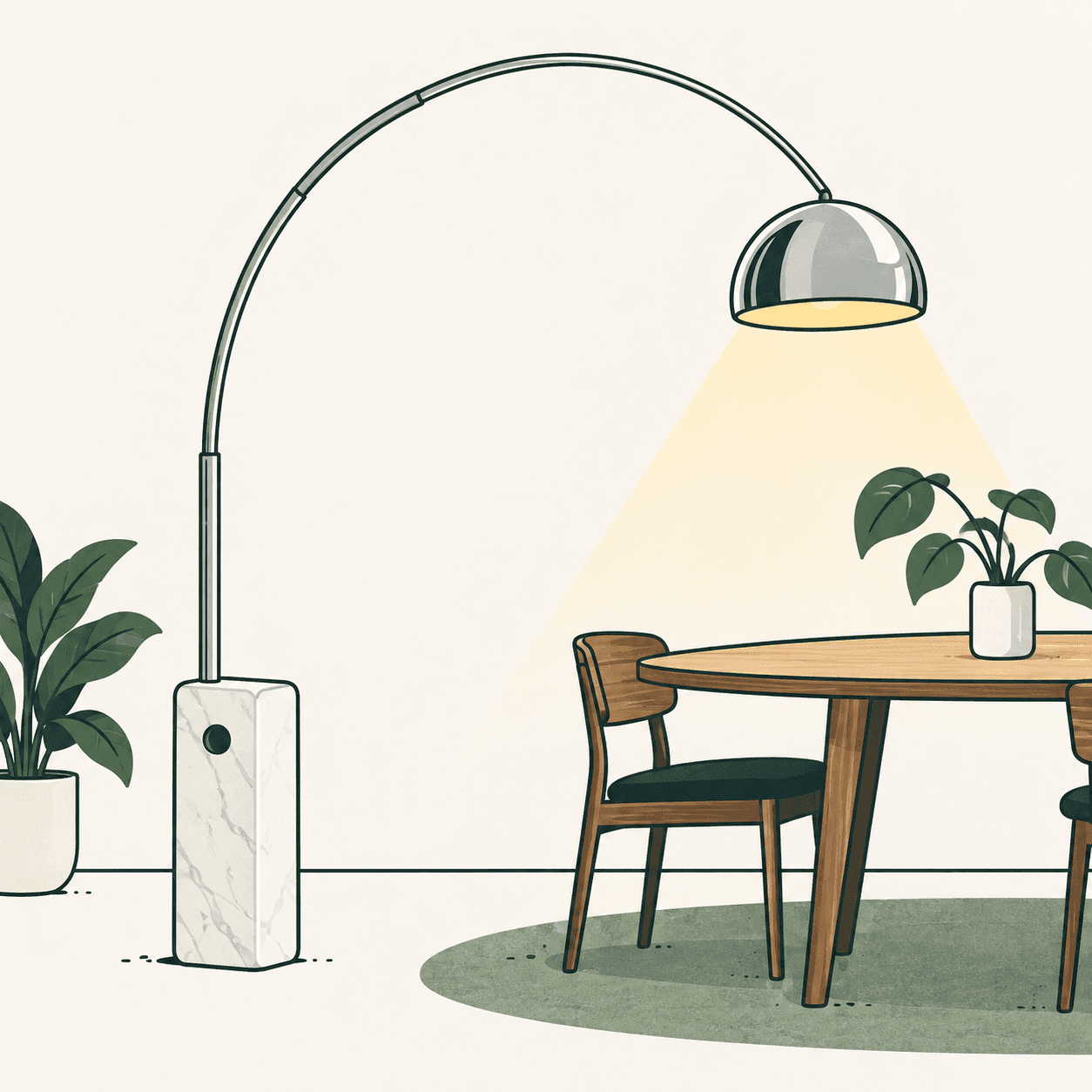
Arco, designed in 1962 by Achille and Pier Giacomo Castiglioni for Flos, provides overhead light without a ceiling attachment. MoMA traces its inspiration to the street lamp, which projects light away from where it stands. A domestic problem was reconsidered by observing the city. [1]
Flos’s current description identifies three main elements: a white Carrara marble base, a telescopic steel stem and an adjustable aluminium reflector. The stone acts as a counterweight. That broad curve is therefore not a line without consequences: how far it reaches also depends on what keeps it balanced down below. [2]
The designers’ description preserved by Pier Giacomo’s archive explains that the stem has three sections sliding inside one another, with the wiring concealed within. The shade meets another practical need: its holes help cool the lamp holder. These are modest details, but they reveal how the object’s shape relates to its operation. [3]
A pole inserted through the base allows the lamp to be moved. MoMA records that the designers also considered room for someone carrying a tray to pass behind a seated diner. The object therefore contains a route as well as a source of light. [1]
Arco belongs to a particularly productive period. In its announcement for a 2022 exhibition about 1962, the Foundation also lists Relemme, Taccia, Toio and Ventosa among that year’s lamps. Our editorial reading of this variety is that the brothers’ method sought different answers, rather than imposing one recognisable silhouette on every problem. [4]
Here is an exercise devised by our editors, not attributed to the Castiglionis. Sketch a room with an off-centre table, a socket and a route to the kitchen. Before inventing a beautiful lamp, draw where the light, cable and person carrying dinner need to go. Look for places where those three routes interfere. This is a concrete way to explore the problem Arco addressed. [2]
The exercise does not prescribe buying an icon or copying its curve. It asks us to assess an object alongside the movements it enables and the obstacles it introduces. Our editorial observation is that a lovely drawing can still get in the way of dinner. By revisiting 1962 through materials and components, the Foundation likewise encourages a closer look at the work. [4]
Take this with youTry describing a household object by the problem it solves. Only then judge its appearance. For once, the ceiling can be excused from the meeting.
Read the sources (4)
- Achille Castiglioni, Pier Giacomo Castiglioni. Arco Floor Lamp. 1962 The Museum of Modern Art · accessed 15 Sept 2026
- Arco — lampada da terra Flos · accessed 15 Sept 2026
- Lampada ARCO — descrizione dei progettisti Archivio Pier Giacomo Castiglioni · accessed 15 Sept 2026
- 1962, blocchi di marmo, manici di scopa e altre storie Fondazione Achille Castiglioni · accessed 15 Sept 2026
Original writing and illustration made with AI assistance. Our editorial method
More in Design