A chair has a structure, but it also has a surface that we encounter with our eyes and bodies. Alexander Girard worked on that second level: he led Herman Miller’s textile division from 1952 to 1973. The central discovery is straightforward. Fabric can help give an interior its character, rather than appearing only at the end as a final colour choice. [3]
MoMA holds Rain Drapery Fabric, made in linen for Herman Miller in 1953. Its record identifies designer, material, date and purpose: a curtain. Those details matter because they prevent us from treating the work as an abstract pattern without a use. Looking at fabric also means asking where it will be seen, how much space it will occupy and what will surround it. [4]
The Girard archive at the Vitra Design Museum brings together drawings, photographs, samples and three-dimensional objects. It connects textiles with graphics, furniture and interiors. Our reading is that a sample should not be isolated from the system it belongs to. A small rectangle on a table and a large suspended surface invite different decisions; that is a design question, not a statement we attribute to Girard. [2]
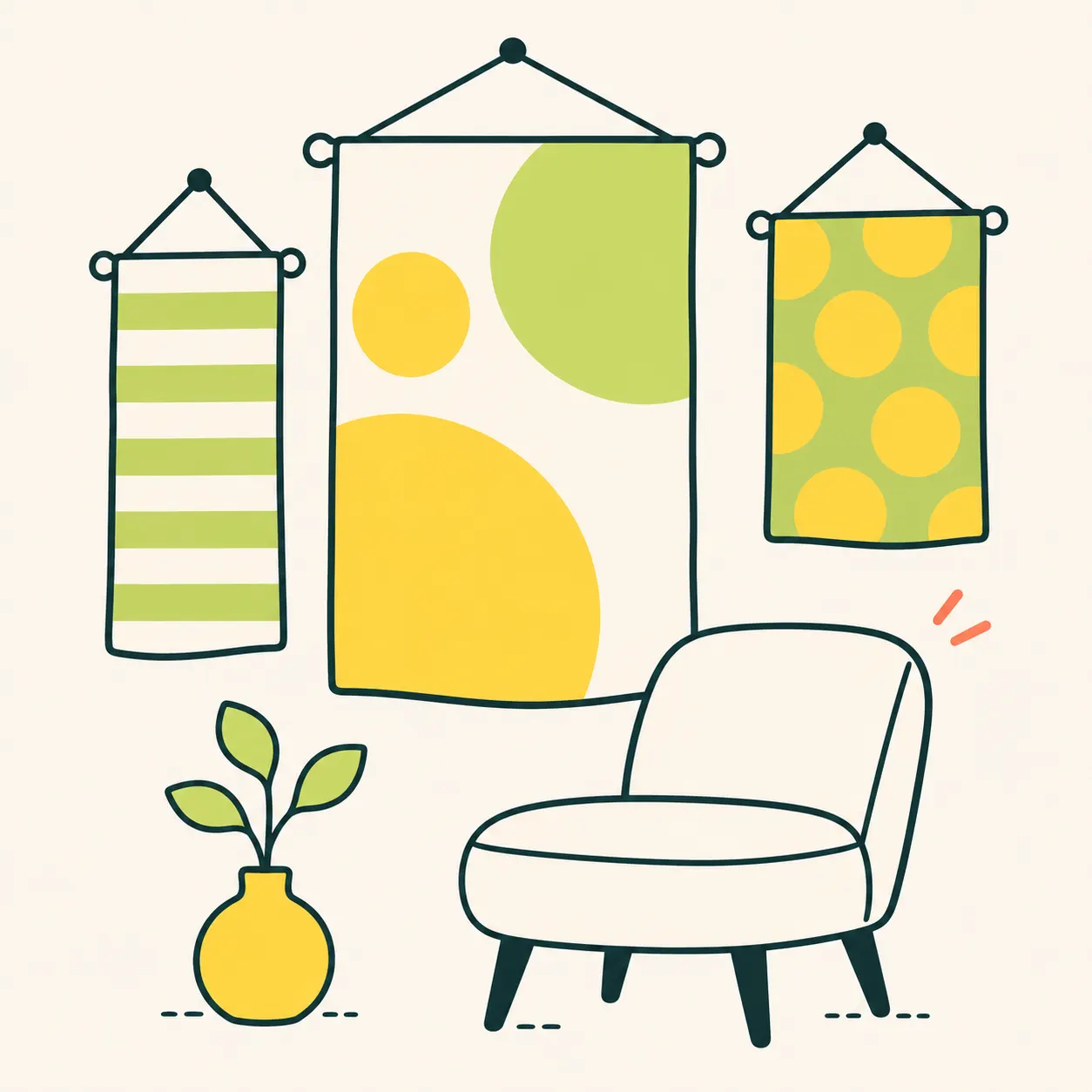
Try this editorial example: draw three identical rectangles and fill them with narrow stripes, broad stripes and a few circles. Keep the colours unchanged. Which feels quieter, and which more insistent? There is no compulsory answer, and we are not reproducing a Girard textile. The exercise separates two choices that we often bundle together: the palette and the scale of a pattern. His work supplies our starting point. [1]
The Henry Ford also documents Textiles and Objects, the New York shop opened in 1961 and conceived by Girard. Fabrics and objects were brought into relationship within a designed setting. We can borrow the question without copying the display: what changes when a swatch sits beside wood, metal or paper? Describe what you notice before announcing that one combination must work for everybody. [3]
Careful archives remind us of a final boundary: a cheerful geometric pattern is not automatically a Girard original. Our accompanying illustration uses invented samples, explicitly presented as an editorial interpretation. The historical designs remain in their sources and identified objects. When considering your next room, it is worth asking what relationship you want between shape, scale and use before delivering a verdict on its colours. [2]
Take this with youLook at a textile close up and then within a room. Describe how its role changes without searching for a universal rule of taste.
One idea, in simple words
Alexander Girard designed textiles for interiors. He led Herman Miller’s textile division from 1952 to 1973. Fabric did more than cover a piece of furniture: its colours and patterns were part of the design. MoMA holds his linen curtain fabric Rain, made in 1953. A sample is a small piece used to examine a material. Imagine drawing two samples in the same colours, one with narrow stripes and another with broad stripes. You can compare them without deciding that either is best for everyone. This is our exercise, not one of Girard’s designs. To identify a real historical design, check its maker, date and description in reliable records. [1][2][3][4]
A little discovery to keep
What did you discover?
Read the sources (4)
- Alexander Girard Vitra · accessed 10 Nov 2026
- Alexander Girard Archive Vitra Design Museum · accessed 10 Nov 2026
- Alexander Girard Designs for Herman Miller The Henry Ford · accessed 10 Nov 2026
- Rain Drapery Fabric, 1953 Museum of Modern Art · accessed 10 Nov 2026
Original writing and illustration made with AI assistance. Our editorial method
More in Design