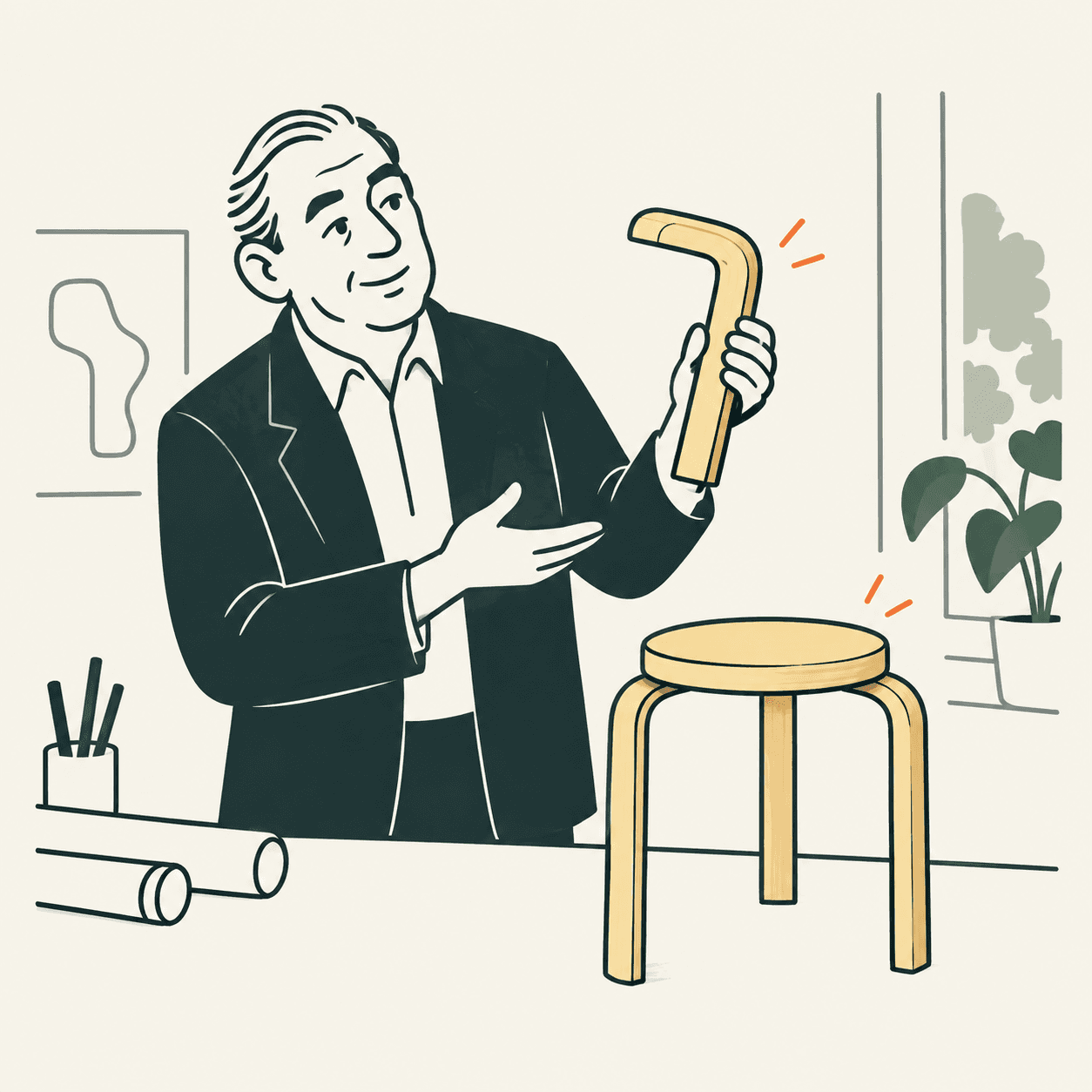
A stool can seem like a solved problem: a surface, some supports, nothing left to discuss. Alvar Aalto’s Stool 60, dated 1933 in MoMA’s collection, invites a closer look at how those parts meet. The museum’s example is birch and stands 43.8 centimetres high: this is a design that enters a room at a human scale. [4]
The crucial move is the L-shaped leg, developed with furniture manufacturer Otto Korhonen. Cuts are made into the end of a piece of wood, then thin strips are glued into them. This preparation helps the component bend and strengthens its stability. Artek describes standard parts used across more than fifty products: one invention can generate a family rather than end with a single object. [2]
The Aalto Foundation explains the next stage: heat and steam help form the right angle. The completed leg screws underneath the seat, avoiding complicated joints that required considerable manual work. The simplicity we see is the result of a precise manufacturing process, rather than an absence of technique. [3]
Three legs and a round seat make up the stool. Artek’s catalogue also presents it as a small table or display surface, and documents stacking and flat-pack transport. Current versions offer different surfaces and finishes; the design principle and the exact materials of an individual version deserve to be distinguished. [1]
A historical use makes the form’s usefulness clear: stools provided additional seating in the lecture hall at Viipuri Library. Stacking them allowed space to be recovered. A construction detail therefore became part of the room’s organisation, making it available for different needs. [3]
Here is an imagined editorial example: in a small home, a conversation requires an extra seat; later, an armchair needs a nearby surface. Sketch both situations, then the moment when the object is put away. Our proposed test is to judge furniture while it changes places, too. The photographed living room represents just one of its working shifts, rather than its entire daily life. [1]
This reading does not make Stool 60 the answer to every room. Inclusion in a museum documents cultural recognition; it cannot determine personal comfort or whether buying one makes sense. For us, its educational value is learning to read a connection: material, production and use can shape one another. Admiring the curve is a start; understanding the problem it addresses makes the observer more demanding. [4][2]
Take this with youLook beneath a piece of furniture without dismantling it: identify a connection and try explaining how it is made, what use it enables and what limitation remains.
Read the sources (4)
- Stool 60 Artek · accessed 15 Sept 2026
- L-leg Collection Artek · accessed 15 Sept 2026
- Stool 60 Alvar Aalto Foundation · accessed 15 Sept 2026
- Alvar Aalto. Stacking Stool (model 60). 1933 Museum of Modern Art · accessed 15 Sept 2026
Original writing and illustration made with AI assistance. Our editorial method
More in Design