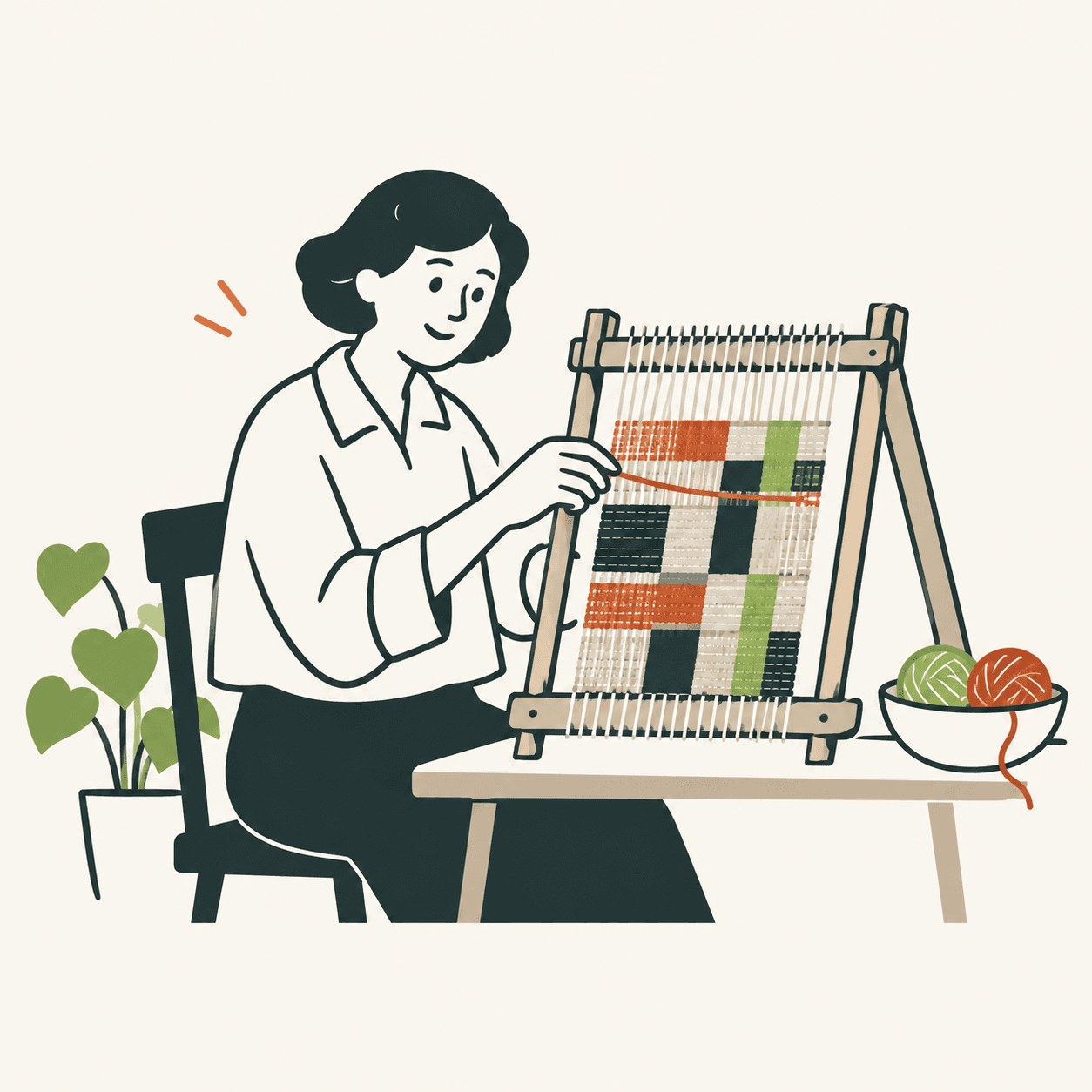
Does a wall have to be solid? Anni Albers, an artist and designer born in Germany, helps us consider other possibilities. MoMA holds her designs for rugs, upholstery and wall hangings. That range opens the question behind this discovery: what changes when a woven surface does more than cover an object, becoming part of the space we live in? [1]
One particular example is Free-Hanging Room Divider, made in 1949 and held by MoMA: a suspended divider using cellophane and cord. The museum draws attention to its translucency and the combination of different materials. This is not a brick wall copied in fabric. It brings separation, transmitted light and a visible weave into the same design. The spaces between threads matter alongside the threads themselves. [2]
Albers made experimenting with materials central to her teaching. The foundation preserving her work traces her path from weaving at the Bauhaus to teaching at Black Mountain College between 1933 and 1949. Technical skill was not dismissed: it could develop through practical problems. We take this as an invitation to test what a material allows before deciding every detail of a design on paper. [3]
Here is an editorial experiment, not a copy of an Albers artwork. Prepare two small cardboard frames and some precut paper strips. Weave the strips close together in one frame, leaving wider gaps in the other. Hold each in front of the same window. Draw what you can see through it: a clear outline, a broken shape, a patch of light? There is no required answer to guess before looking. [2]
Now imagine a room with one corner for reading and another for conversation. Which sample would you choose as a tiny model of a divider? Write down your reason, then compare it with someone else’s. Perhaps one of you wants privacy while the other wants to see who is approaching. In our workshop, both needs deserve attention. The useful decision connects a material with a purpose, instead of declaring one weave the most beautiful in every situation. [3]
A paper model has obvious limits. It cannot establish whether a real divider would be durable, safe or suitable for a noisy room. We should not claim properties that we have never measured. Its job is to help us ask a better question and choose a next test. Our reading of Albers’s work is that design can organise relationships between solid areas and gaps, or between a person and a room, before we even start choosing decoration. [1]
Take this with youLook at a curtain as a tiny piece of architecture. What does it separate, what does it reveal, and what would you change for a different purpose?
One idea, in simple words
Anni Albers designed textiles, which are made by weaving threads together. In 1949 she made a room divider: an object that separates parts of a room. She used cord and cellophane, a clear material. Her divider separated space without closing it off like a solid wall. The gaps between the threads mattered too. [2]
Try this example invented by our editors. Place paper strips close together inside one frame and farther apart inside another. Hold each frame in front of a window. Which lets you see more of what is behind it? Which hides more? We are not building a real wall. We are comparing two ideas, then choosing a design that suits a particular need. [3]
A little discovery to keep
What did you discover?
Read the sources (3)
- Anni Albers The Museum of Modern Art · accessed 29 Sept 2026
- Anni Albers. Free-Hanging Room Divider. 1949 The Museum of Modern Art · accessed 29 Sept 2026
- Teaching: Anni Albers The Josef and Anni Albers Foundation · accessed 29 Sept 2026
Original writing and illustration made with AI assistance. Our editorial method
More in Design