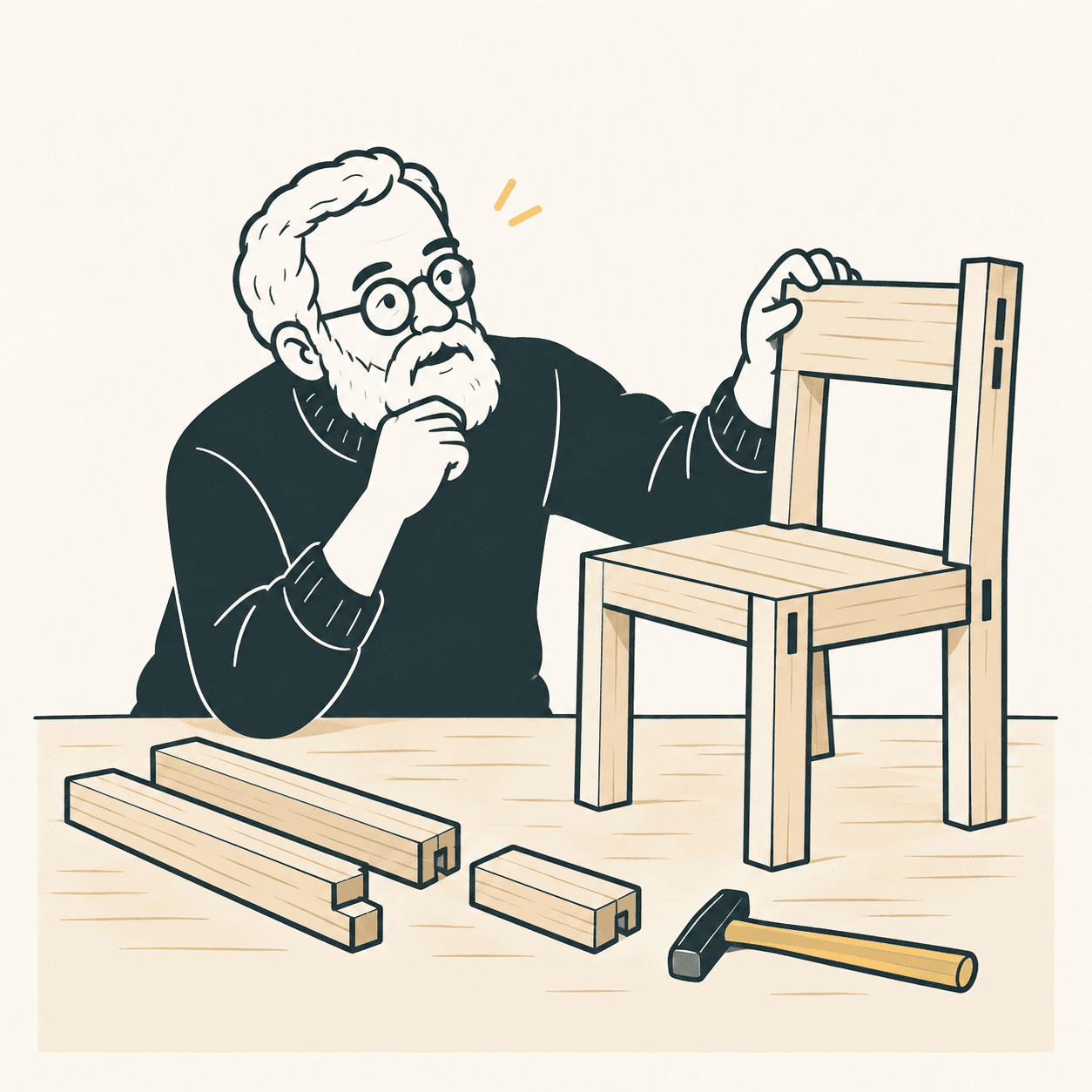
In 1974, Enzo Mari published Proposta per un’autoprogettazione, a manual of furniture drawings using readily available timber and nails. The Design Museum’s teaching notes explain its purpose: helping people who use objects understand design. Copies were sent on request for the cost of postage, and Mari invited photographs of completed pieces and variations. Participation therefore continued beyond the final page, through the work and responses of the people building the furniture. [1]
This concern with making also extended to industrial production. Triennale Milano describes the Java cheese container: Mari rethought its hinge to avoid repeatedly assembling three separate elements. The container and lid themselves formed the hinge when fitted together. The object makes a question visible beyond visual appeal: what work does this shape require? In the museum’s account, the movements of the person making the object belonged within the design discussion. [2]
The reception of Autoprogettazione reveals an instructive limit. The London retrospective’s guide reports that many readers mainly admired its rustic appearance or treated the project as an endorsement of DIY. Mari hoped for a more critical understanding of objects. A piece of furniture can be successfully built from instructions without conveying that message: reproducing a shape and questioning its reasons remain two different activities. [3]
Here is an example devised by our editorial team, not an exercise attributed to Mari. Imagine comparing two small shelves already installed, without dismantling or altering them. One conceals every connection; in the other, we can trace the relationship between shelf and supports with our eyes. Try drawing both and explaining to someone else what you understand. Where an answer is missing, write a question: how is it attached, how is it cleaned, what could be replaced? The sketch neither certifies safety nor decides which shelf is better. It simply turns an impression into points to check. This is our application of the question, not a universal formula for good design. For once, the catalogue must endure questions beyond the choice of colour. [1]
Take this with youTry this: choose an everyday object and note one thing its shape helps you understand and one thing you would like to check. Looking more carefully can start with a concrete question.
Read the sources (3)
- Enzo Mari: Design as a Language to Change the World! Design Museum · accessed 18 Sept 2026
- Enzo Mari and the Museo del Design Italiano Triennale Milano · accessed 18 Sept 2026
- Enzo Mari: Large Print Guide, mostra 2024 Design Museum · accessed 18 Sept 2026
Original writing and illustration made with AI assistance. Our editorial method
More in Design