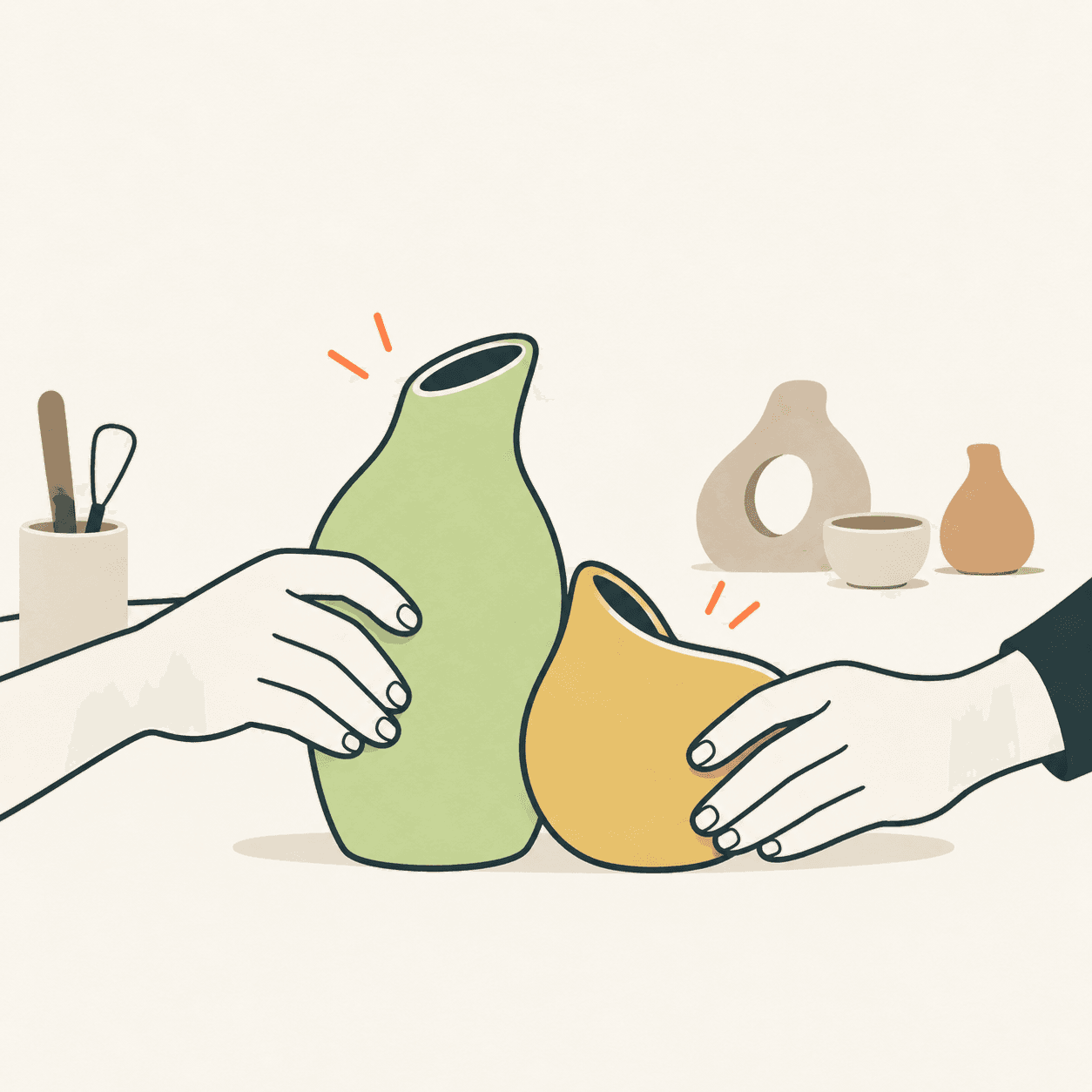
A salt shaker and a pepper shaker can convey something before anyone uses them. Eva Zeisel, born in Budapest in 1906, moved from studying painting to an apprenticeship in a pottery workshop. In her everyday objects, the search for beauty met the requirements of the table. [1]
Consider the Town and Country pair, designed in the mid-1940s for Red Wing. One piece is taller, the other shorter; their rounded volumes seem to lean towards each other. Museum der Dinge interprets these organic forms as suggesting a relationship between people. The pieces need not be identical to look like a pair: their kinship emerges through their curves and their positions relative to each other. [2][3]
This sense of familiarity did not exclude industrial production. Cooper Hewitt explains that Red Wing used moulds to make the series, rather than building or throwing each piece by hand. Visual softness, then, does not prove that an object was individually handcrafted. Relationships between different objects also mattered to Zeisel: a family of forms could contain distinct characters that still belonged together. [4]
Try an editorial exercise, rather than a reconstruction of her method. Cut two rounded shapes from paper, one tall and one short. Bring them together, then rotate just one. Ask whether they now seem to seek each other out, turn their backs or ignore each other. The material has not changed, and we have added no decoration: we have changed a relationship. Draw the small empty space between them too, treating it as a third shape to examine. [2]
Continue this editorial example with two containers already at home. Place them close together on a table, then further apart, without buying anything new. If the arrangement looks pleasing, ask separately whether the containers are easy to grasp and tell apart when needed. These are different questions. Observing forms can suggest an expressive intention; it does not, by itself, measure ease of use. The pair's presence in museum collections today cannot replace that practical assessment. [5]
Even the date needs care: MoMA catalogues the pair as around 1945, while Cooper Hewitt gives 1946 for the line's introduction. Here we retain the broader description, mid-1940s, without turning different records into a more precise chronology than the evidence supports. The point visible in the objects remains concrete: designing a pair means considering each element and the relationship it establishes with the other. [3][4]
Take this with youMove two objects around a table and observe the gap between them. Then separate two judgements: how they look together and how easy they are to use.
One idea, in simple words
Eva Zeisel designed ceramic objects, including containers for the table. Her Town and Country salt and pepper shakers have rounded forms and different sizes. Placed together, they look like two figures in a relationship. Being a pair does not mean having the same shape. [1][3]
Here is an editorial example. Cut out two paper shapes, one large and one small. Bring them together, then turn one of them. Their visual relationship changes, although the cut-outs themselves remain the same. Look at the empty space between them too. This activity helps us observe an arrangement. It does not prove that a real container is easy to use: that would need a practical check. [5]
A little discovery to keep
What did you discover?
Read the sources (5)
- Eva Zeisel's Playful Search for Beauty Cooper Hewitt, Smithsonian Design Museum · accessed 4 Oct 2026
- Salt and Pepper Shaker by Eva Zeisel Werkbundarchiv – Museum der Dinge · accessed 4 Oct 2026
- Eva Zeisel. Town and Country Salt and Pepper Shakers. c. 1945 The Museum of Modern Art · accessed 4 Oct 2026
- Coming Together Cooper Hewitt, Smithsonian Design Museum · accessed 4 Oct 2026
- Objects of Our Affection: Eva Zeisel’s Town and Country salt and pepper shakers Carnegie Museums of Pittsburgh · accessed 4 Oct 2026
Original writing and illustration made with AI assistance. Our editorial method
More in Design