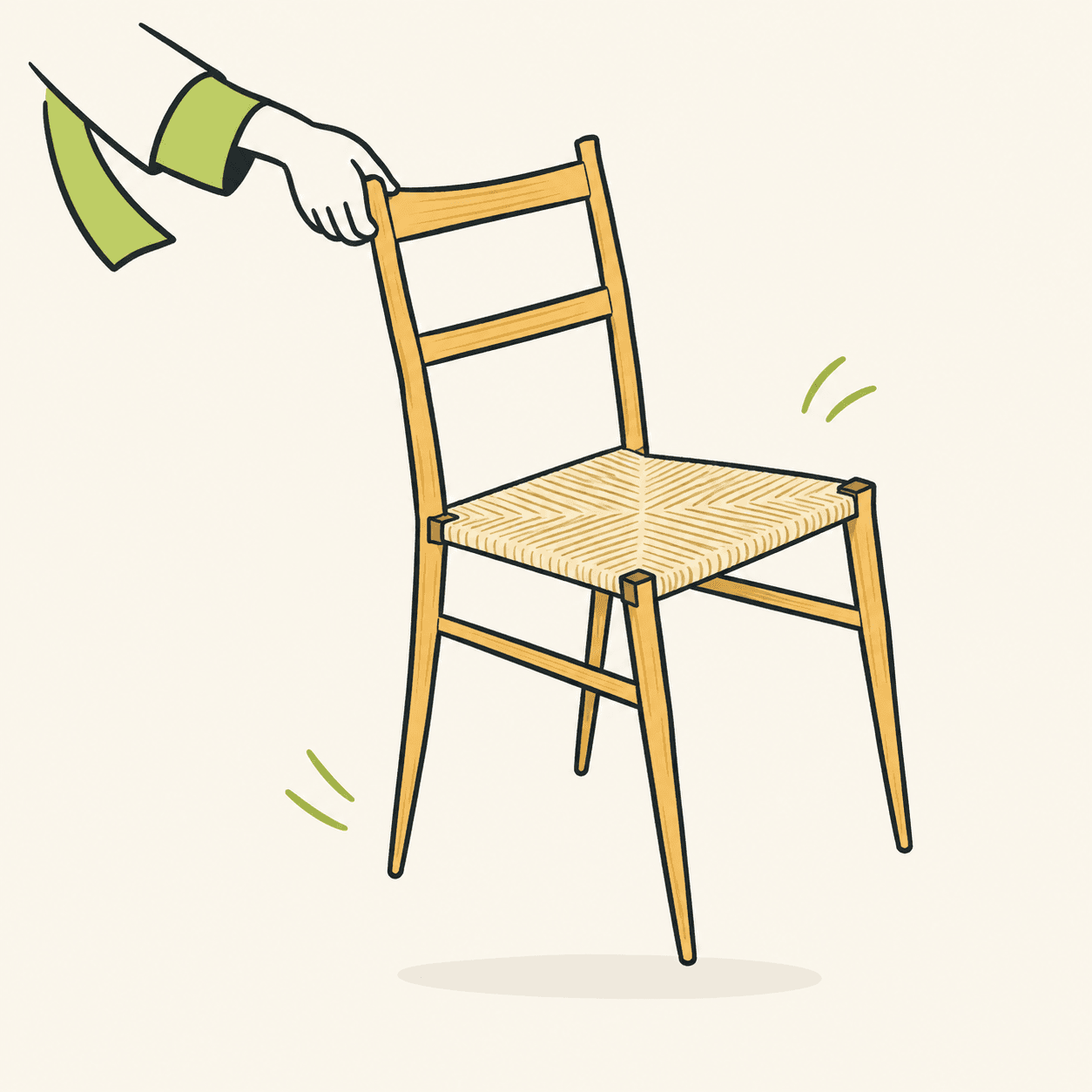
A chair can look light before anybody lifts it. Gio Ponti's Superleggera, designed in 1957 and manufactured by Cassina, turns that impression into a concrete question: how can weight be reduced without losing the ability to support a person? MoMA holds an example made of ash and rattan. This is a discovery from design history, rather than a new product announcement today. [1]
Cassina gives a weight of 1,700 grams and a leg cross-section of just eighteen millimetres. These are characteristics stated by the manufacturer for the design, not measurements made by our editors. The figures nevertheless reveal a choice: lightness concerns more than the chair's appearance. It also concerns how much material a person must move when picking it up from the floor. [2]
Different woods perform different jobs. Cassina's presentation distinguishes the ash frame from the beech seat surround. The Gio Ponti archive's store also describes the craftspeople's work on the tenon joint: a shaped part of one wooden component fits into its counterpart. The meeting between pieces matters as much as the shape of each separate piece. A quiet detail becomes central to the whole design. [2][3]
Imagine an example invented by the editors, without building or testing a chair. Arrange four pencils as the sides of a square on a table. While their ends remain loose, they do not form a joined structure. This example neither reproduces the Superleggera's construction nor demonstrates its load capacity. It simply shifts attention from separate lines towards the way those lines are connected. [3]
From this perspective, calling the design merely minimal tells us too little. That is an editorial interpretation: we can count the visible components, but we should also ask why each is present, how it is worked and how it meets its neighbours. The archive's description credits both Ponti's research and the experimental and manufacturing skills of Cassina and its craftspeople. The designer's name does not describe all the work involved. [3]
There is an important limit when looking at our illustration: it is a free interpretation of lightness, not a construction drawing of the historical model. To recognise the actual design, return to the photographs and collection records cited here. Nor does a slender shape, by itself, certify the strength of any other object. The useful question is not how little we can see, but how well every part contributes to the whole. [1][2]
Take this with youLook at a chair without taking it apart: find three places where two components meet. Try describing what those joints do, as well as how they look.
One idea, in simple words
Gio Ponti designed a chair called Superleggera in 1957. Its name points to a clear idea: it weighs very little. Cassina, the company that makes it, gives a weight of 1,700 grams. But a chair must also support the person sitting on it. Thin legs alone are not enough: the whole structure needs careful design. [2]
An important part is the joints. A joint can connect two wooden pieces by fitting a shaped part into another piece. Craftspeople worked on these connections for the Superleggera. Here is an editorial example: four pencils arranged as a square remain separate if their ends are not joined. This is not a strength test. It simply helps us understand why connections between parts matter. [3]
A little discovery to keep
What did you discover?
Read the sources (3)
- Gio Ponti. Superleggera Chair (model 699). 1957 The Museum of Modern Art · accessed 6 Oct 2026
- 699 Superleggera · Gio Ponti, 1957 Cassina · accessed 6 Oct 2026
- Superleggera chair with upholstered seat Gio Ponti Store · accessed 6 Oct 2026
Original writing and illustration made with AI assistance. Our editorial method
More in Design