In Calyx, the textile Lucienne Day designed in 1951, plants are not reproduced as they would be in a botanical illustration. The forms approach abstraction: fine stems, dots and connected shapes suggest growth. The V&A explains that the design accompanied an interior furnished by Robin Day at the Festival of Britain. The interesting question is how an impression of nature can survive a change of visual language. [1]
The National Gallery of Victoria identifies its example of Calyx as screenprinted linen, crediting Lucienne Day with the design and Heal’s with its manufacture. We can therefore distinguish three things: the idea for the pattern, the technique used to print it and the fabric receiving it. Looking only at the design, isolated on a screen, leaves out two important parts of the object documented by the museum. [2]
An editorial example: place a small branch on a table and draw it three times. Keep many leaf veins in the first sketch, just the outline in the second, and two lines with a curved shape in the third. Ask which version still suggests the plant and which creates an interesting rhythm instead. We are not reconstructing Day’s personal working method. This is our own exercise in noticing the distance between an object and a mark. [1]
Her exploration did not stop at printed fabrics. In her later silk mosaics, colour emerged from neighbouring small squares and strips. The V&A explains that Day planned the compositions on graph paper and employed skilled assistants to sew them. A pattern no longer had to repeat across a length of cloth: each work could have an independent composition, within the constraint imposed by those small units. [3]
A second editorial exercise: cut out paper squares in three colours and arrange a shape. Change only the gaps, then only one colour. Photograph the versions so you can compare them without immediately declaring a winner. Ask where your eye lands first, which shapes seem to draw together, and which areas need more breathing room. The activity explores a compositional problem; it reproduces neither an original mosaic nor its construction in silk. [3]
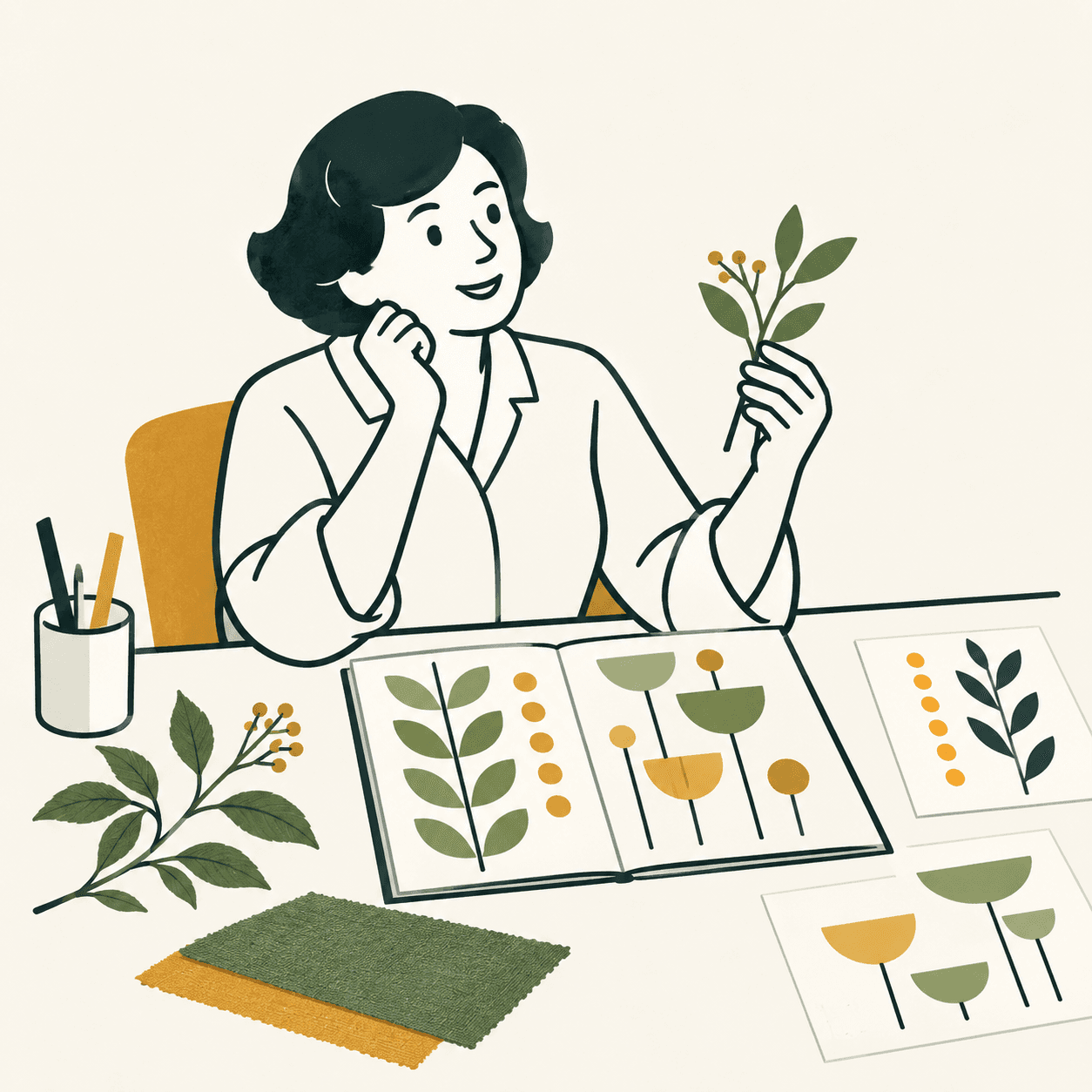
Calyx and the mosaics therefore offer two situations to compare: a design intended for a textile surface and a composition assembled from stitched elements. That is our interpretation, not a formula attributed to the designer. Our illustration is also an editorial interpretation: its fabric samples are invented, rather than archival documents. To examine an authentic work, return to the images and collection records provided by the museums. [2][3]
Take this with youTry removing one detail from a drawing of your own: what must remain for the idea to stay recognisable?
One idea, in simple words
Lucienne Day designed patterns for fabrics. A pattern is a group of shapes arranged across a surface. Her Calyx design, from 1951, suggests plants without copying every leaf. Thin lines and simple shapes help create that impression. A museum records Calyx as a design printed on linen, a type of fabric. The pattern and the material are different parts of the same object. [1][2]
Here is our editorial example: draw a leaf with all its veins, then draw it using just its outline. Can you still recognise it? Later, Day also designed silk mosaics, pictures assembled from tiny fabric squares and strips. Skilled assistants sewed them. These examples show different ways to organise shapes and colours. Our drawing is an interpretation, not an original work by Day. [3]
A little discovery to keep
What did you discover?
Read the sources (3)
- Lucienne Day – an introduction Victoria and Albert Museum · accessed 2 Oct 2026
- Calyx, fabric length National Gallery of Victoria · accessed 2 Oct 2026
- Lucienne Day’s silk mosaics Victoria and Albert Museum · accessed 2 Oct 2026
Original writing and illustration made with AI assistance. Our editorial method
More in Design