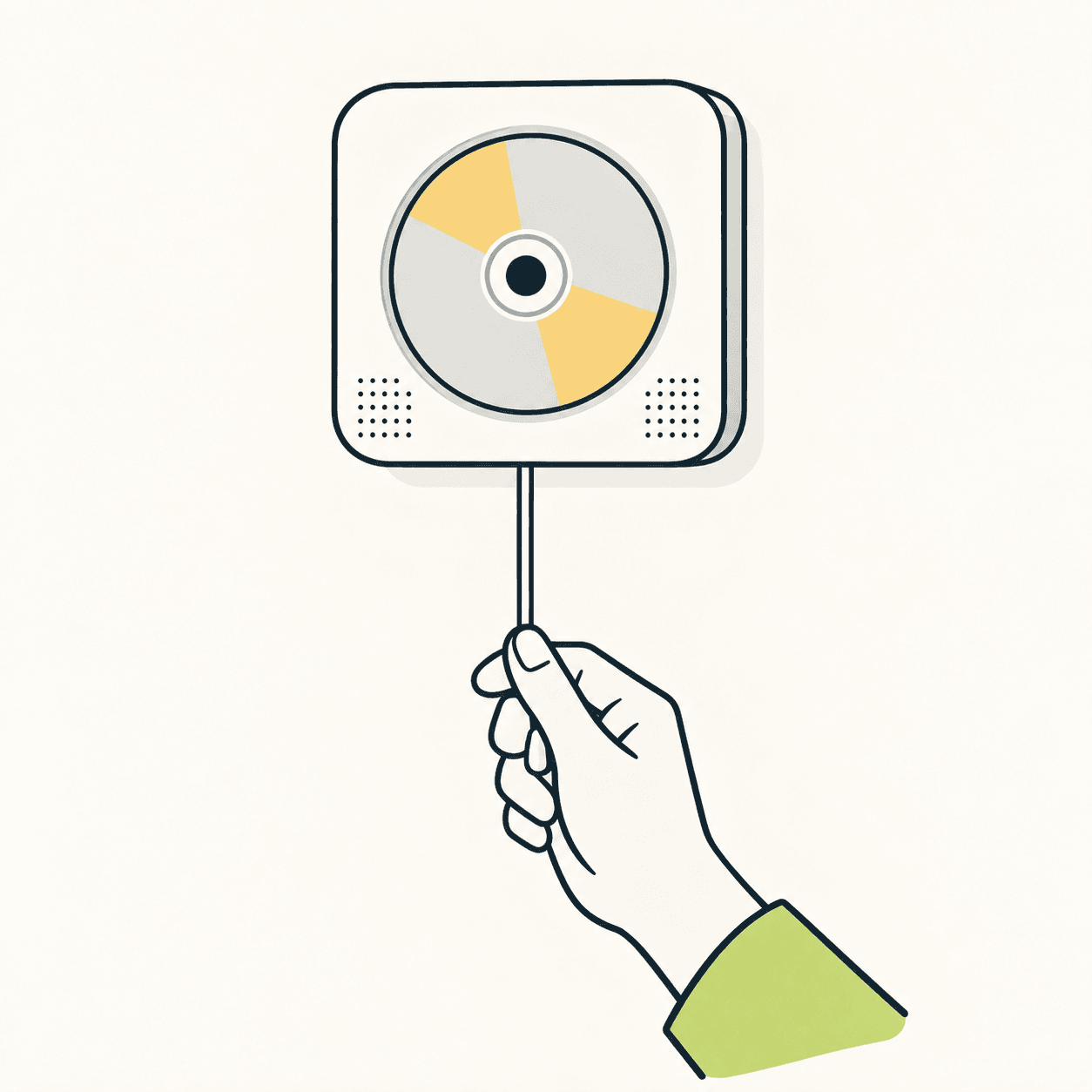
How much design can fit into a gesture as small as pulling a cord? Naoto Fukasawa's wall-mounted CD player, dated 1999 in the MoMA collection, offers a concrete answer. A square body made of ABS plastic houses the disc and electronic components. Looking at it only as an arrangement of shapes, however, leaves out the most interesting part: its encounter with the person using it. [1]
In MUJI's public presentation, Fukasawa describes pulling the cord and sound flowing into the space. The movement of the hand belongs to the designed experience. We can read it this way: the control is not separate from the object, but becomes the point where a person enters into a relationship with it. This is the editors' interpretation, starting from the designer's own explanation of the experience. [3]
Fukasawa calls his interest in behaviours we perform without explicit deliberation Without Thought. His studio documents workshops under that name beginning in 1999. It does not mean designing without thinking. Instead, the designer's attention turns towards habits and expectations that often remain in the background. Even a familiar object can become a question when we observe how somebody touches it. [2]
Try an example invented by the editors. Two people enter a room and need to switch on an unfamiliar lamp. One looks for a button on the cable; the other searches beneath the shade. Before judging which solution is better, note where they look, what they recognise and when they hesitate. We are not measuring their intelligence: we are observing how well a design meets their expectations. The same shape might suggest different actions to people with different experiences. [2]
Return to the player. MoMA's record describes an object around seventeen centimetres wide, given by MUJI. These details distinguish a specific design from a general idea of simplicity. Its interest does not end with its pale colour or the number of visible elements. In our editorial reading, the relationship between size, position on the wall, hand movement and listening matters most. [1]
This also raises a useful limit. A gesture that seems obvious to us is not automatically accessible or intuitive for everyone. That is an editorial design question, not the result of a user study of this product. Observing a control also means asking who can reach, recognise and operate it. Simplicity deserves to be tested in encounters with real people as well as admired in a photograph. [2]
Take this with youChoose an everyday object and describe it with three verbs. Then observe whether another person actually makes those movements, in the order you imagined.
One idea, in simple words
Naoto Fukasawa is a designer: he plans objects while also thinking about how we use them. In 1999 he designed a CD player to hang on a wall. A CD is a disc that can hold music. The player has a square shape and a hanging cord. Pulling the cord starts the music, making the movement of a hand an important part of the design. [1][3]
Fukasawa observes gestures we make almost without thinking. Imagine this editorial example: you try to switch on an unfamiliar lamp. Where do you look for the button? Your choice can help a designer understand your expectations. Not everybody looks in the same place. A simple object deserves attention while being used, as well as when standing still. [2]
A little discovery to keep
What did you discover?
Read the sources (3)
- Naoto Fukasawa. Wall-mounted Compact Disc Player. 1999 The Museum of Modern Art · accessed 5 Oct 2026
- About: Naoto Fukasawa / Product Designer Naoto Fukasawa Design · accessed 5 Oct 2026
- Fact Sheet: Products MUJI USA · accessed 5 Oct 2026
Original writing and illustration made with AI assistance. Our editorial method
More in Design