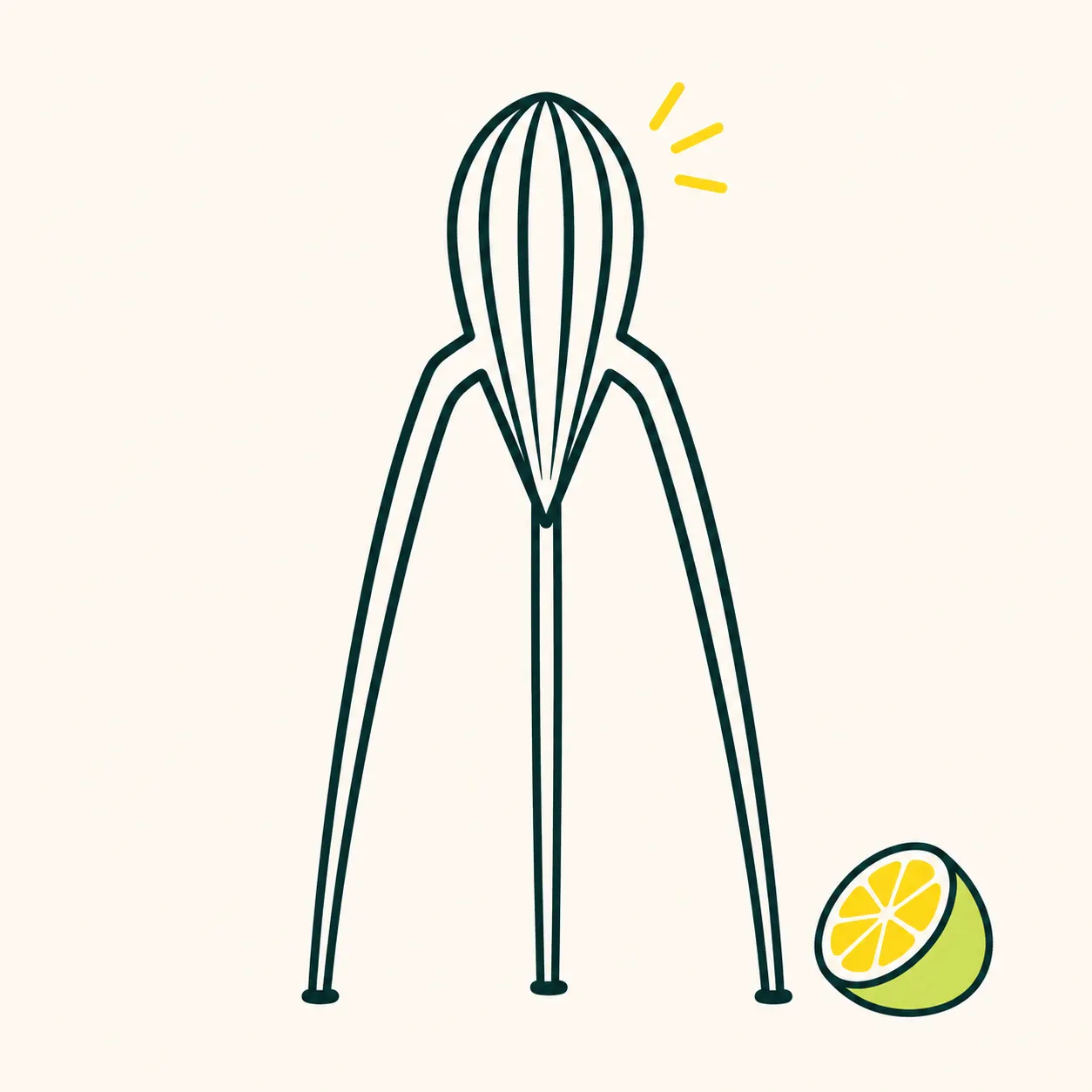
Three slender legs, a grooved body and a gap for a glass: Juicy Salif asks for a moment of attention before revealing itself as a citrus squeezer. The Metropolitan Museum attributes this 1990 object to Philippe Starck and manufacturer Alessi. It describes both a utensil and a sculptural presence. That double reading is the discovery: recognising a task does not exhaust everything a shape might suggest to someone looking at it. [1]
The Powerhouse record helps us follow the action. Juice runs straight into a glass instead of passing through a strainer into a collecting dish; pulp and pips can follow it. The shape has an elongated head and three very tall supports. The empty area underneath is therefore more than a visual pause: it accommodates the receiving vessel. Looking at what is absent becomes as useful as looking at what has been made. [2]
The exhibition devoted to Starck at MoMA PS1 in 1999 placed furniture and household objects among organic shapes and imaginative associations. We need not turn every product into a manifesto to recognise the approach. A familiar object can be reconsidered by asking what image it evokes as well as what action it permits. The resemblance to a small visitor from space is our playful interpretation here, rather than a technical explanation of how the squeezer works. [3]
Try an editorial comparison: imagine a squeezer with a collecting dish beside this tripod. With the first, we might immediately locate the collecting area; with the second, we would add a glass and work out its position. This is no comparative performance test, and fame does not demonstrate greater convenience. It separates several questions: how much juice we obtain, what needs cleaning, how readily we understand the action, and what we want to keep on display. [1][2]
Museums can also emphasise different qualities in the same piece: the Met stresses its sculptural presence, while Powerhouse discusses its innovative and controversial character. We do not need one exclusive label to appreciate it. A utensil can make us smile and still deserve practical assessment. It offers a reason to inspect the kitchen as a collection of decisions: each grip, support and empty space guides an action, even when it initially looks merely decorative. [1]
Take this with youChoose a familiar utensil and describe it without naming it. Then identify the action it permits and the space it needs. This small editorial exercise separates recognition, use and imagination without declaring one design the winner.
One idea, in simple words
Juicy Salif is a citrus squeezer designed by Philippe Starck and made by Alessi. The Met museum dates it to 1990. It has an elongated grooved body and three tall legs. A glass goes underneath, so the juice runs straight into it. There is no collecting dish with a strainer, so pulp and pips can also pass through. Its shape might remind you of a fantastic object, but that resemblance is different from its function. We can notice two things separately: how a tool works and what it makes us imagine. For example, look at the room needed for the glass. Empty space is part of the design. Being in a museum does not prove it is the best squeezer for everyone. [1][2][3]
A little discovery to keep
What did you discover?
Read the sources (3)
- Juicy Salif Lemon Squeezer, 1990 The Metropolitan Museum of Art · accessed 5 Nov 2026
- Juicy Salif lemon squeezer by Philippe Starck for Alessi Powerhouse Collection · accessed 5 Nov 2026
- Philippe Starck: Furniture and Objects — exhibition, 1999 MoMA PS1 · accessed 5 Nov 2026
Original writing and illustration made with AI assistance. Our editorial method
More in Design