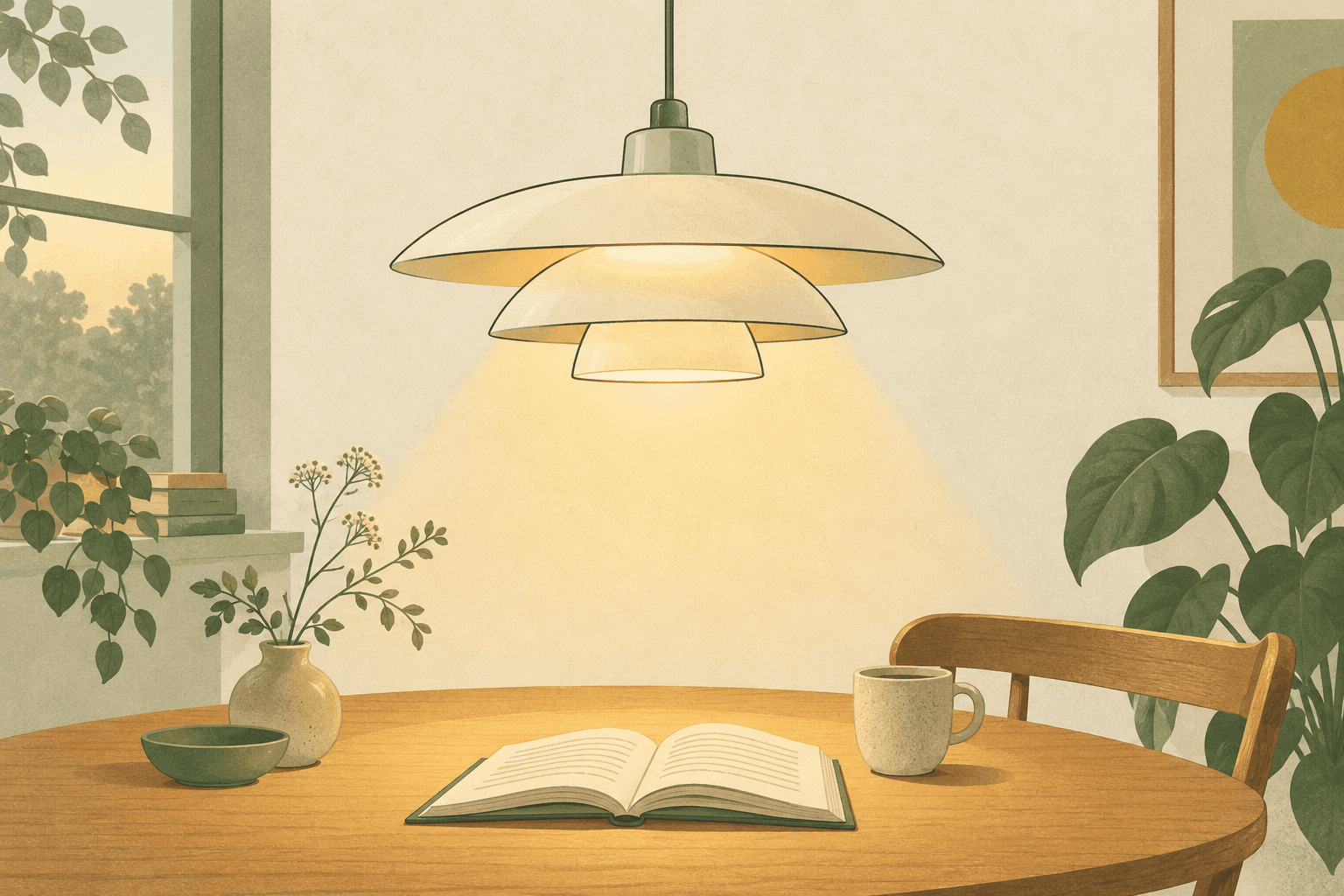
A lamp can look beautiful when switched off and feel uncomfortable when switched on. Poul Henningsen addressed that gap between object and experience. The Danish Architecture Center traces his experiments with harsh electric light: collaboration with Louis Poulsen from 1924, a Paris presentation in 1925 and development of the three-shade system in 1926. The question concerned where light went, not simply what the lamp looked like. [1]
According to the manufacturer, the reflecting shades use geometry based on a logarithmic spiral. Their surfaces and distance from the source help distribute light and control shadows. Painted metal and glass produce different effects. There is no mysterious power in the silhouette: geometry works together with material. The commercial description documents the design principle, rather than providing independent measurements for every possible room and household arrangement. [2]
Another project makes that attention visible. Designmuseum Danmark describes the Artichoke lamp, called Koglen, designed in 1957 for Copenhagen’s Langelinie Pavillonen restaurant: 72 elements arranged in 12 rows shield the source. Those numbers belong to that particular design. They should not be transferred to the three-shade family, as though every Henningsen creation were an identical variation of the same object or used exactly the same construction. [3]
Try this editorial example. Draw a table from the side, a lamp and two people, one sitting and one standing. Trace a route towards the book, then towards each pair of eyes. We are not calculating a lighting installation or copying a Henningsen drawing. We are changing the question: beyond illuminating an object, what does its user actually see? The viewing position becomes part of the design problem. [2]
The exercise has a useful limit. A drawn arrow does not measure a room’s brightness, and an attractive photograph alone cannot establish a reader’s comfort. Our editorial lesson is to separate three judgments: the object’s profile, the behaviour of light and the person’s experience. We can consider them together without compressing them into one verdict, beautiful or ugly, delivered while looking through a shop window. [1]
Take this with youObserve a switched-on lamp without staring at its source: which surface does it illuminate, and where are you standing? That is a design question before a question of taste.
One idea, in simple words
Poul Henningsen designed lamps by thinking about the journey of light. A bulb can light a book but also bother your eyes. His three-shade system, developed in 1926, uses overlapping surfaces to direct light. A shade is a part that intercepts and redirects it. It does more than decorate the lamp or give the object an interesting outline. [1]
Here is an editorial example: draw someone sitting and someone standing beside the same table. Ask what each person sees. The lamp stays the same, but the viewpoint changes. This drawing does not measure brightness. It helps us remember to consider an object while it is being used, rather than only judging it when switched off. [2]
A little discovery to keep
What did you discover?
Read the sources (3)
- Poul Henningsen Shed Light on More Than Our Homes Danish Architecture Center · accessed 7 Oct 2026
- PH 4/3 Table · about this product Louis Poulsen · accessed 7 Oct 2026
- Poul Henningsen, Artichoke lamp, 1957 Designmuseum Danmark · accessed 7 Oct 2026
Original writing and illustration made with AI assistance. Our editorial method
More in Design