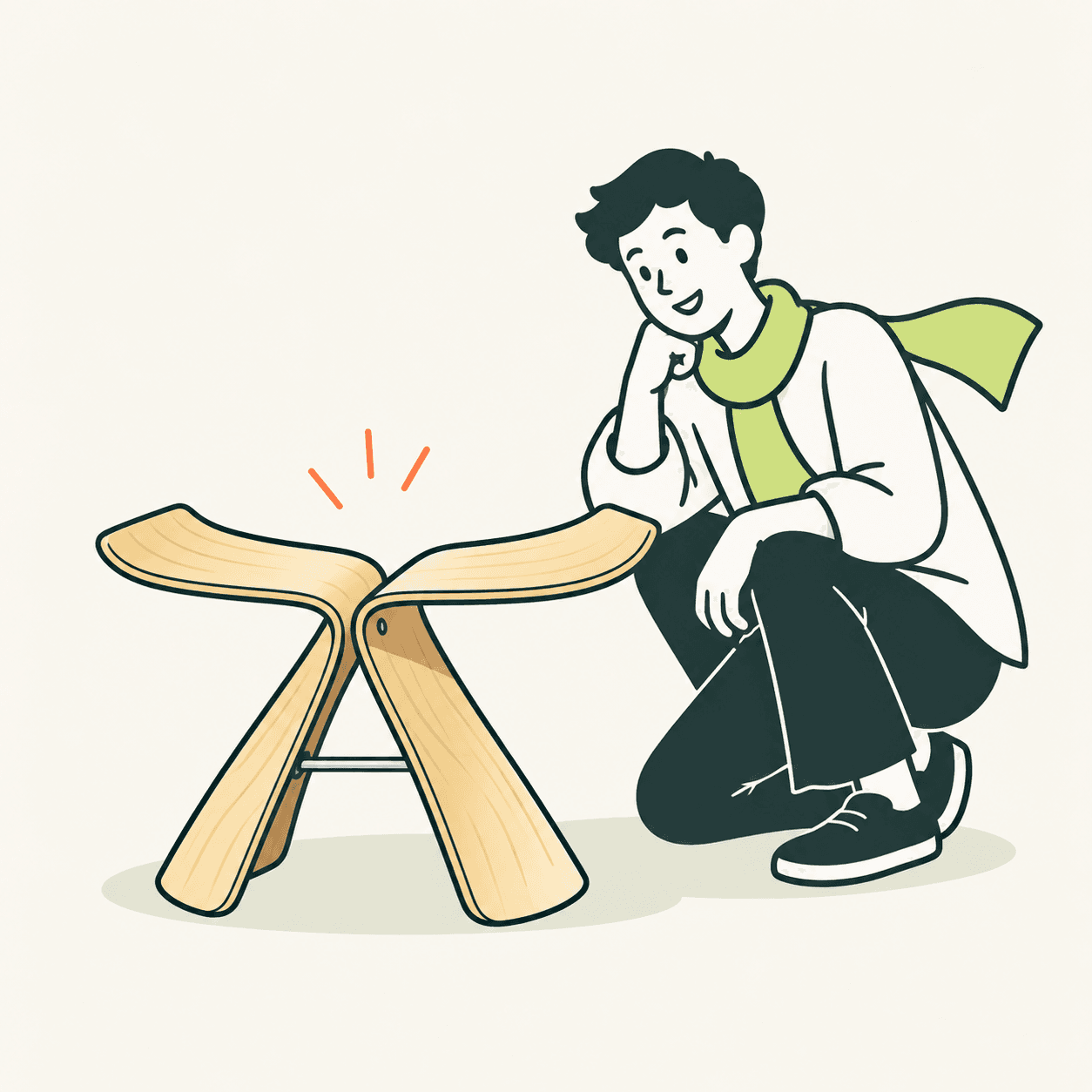
A stool may look simple yet raise an interesting question: where does the seat end and where do the legs begin? Japanese designer Sori Yanagi makes that question visible in his Butterfly Stool. MoMA holds an example made of moulded plywood and metal, dated 1956. Looking closely lets us investigate an everyday object without already being a furniture maker or an expert in design history. [1]
The Metropolitan Museum describes the key idea: two curved wooden sections, shaped rather like upside-down Ls, each form one leg and half of the seat. A metal bar between the legs holds the structure together. As we look, we can follow one continuous piece from the place where someone sits down towards the floor. One part carries out jobs that we might normally picture as separate. [2]
The name Butterfly offers a memorable comparison: Vitra relates the two curved surfaces to wings. That resemblance helps us remember the shape, but does not explain its construction by itself. Dates also need care. The Met records a 1954 design and a 1987 manufacture date for its example, while Vitra presents the model as 1956. We keep those catalogue statements distinct rather than silently choosing one to replace the others. [3][2]
Try this exercise invented by our editors. Draw any stool, giving different colours to the seat, the supports and the connections. Then look at the Butterfly photograph in the museum record. Try following each curved piece without lifting an imaginary pencil. Where would you change colour? Finding that difficult can teach us something: dividing an object into its jobs is not always the same as dividing it into separate pieces. [2]
You could continue with two prepared cardboard strips, bending them into similar shapes and placing them beside each other in a tiny model. This editorial experiment explores an outline; it does not reproduce the stool. Move the strips and notice how the opening between them changes. Do not stand or sit on the model. Exploring an idea on a small scale cannot establish that a real piece of furniture will support a person. [3]
For us, the lesson is not to find a butterfly hiding in every object. It is to ask useful questions: which parts can I see, where do they meet, and what should they allow someone to do? Choose something on your table and describe it without saying beautiful or ugly. A curve, an edge or a connection may already reveal a decision. A museum can train our attention as well as introduce us to famous names. [1]
Take this with youFollow one part of an object with your eyes. Does it do one job or connect two? Draw that path before deciding what you think.
One idea, in simple words
Sori Yanagi was a designer: he planned useful objects. In his Butterfly Stool, two pieces of wood curve around. Each makes half of the seat and one leg. A metal bar connects them. The part you sit on and the part reaching the floor do not always have to be separate pieces. [2]
Butterfly is a clue to the shape: the two curves suggest wings, and the name helps us remember them. Try this game from our editors. Look at its photograph and follow one piece with your finger, without touching the screen. Start at the seat and end at the leg. Then draw a stool of your own. Which parts did you separate? Which did you join? You are spotting decisions behind a shape. [3]
A little discovery to keep
What did you discover?
Read the sources (3)
- Sori Yanagi. Butterfly Stool. 1956 The Museum of Modern Art · accessed 30 Sept 2026
- Sori Yanagi: “Butterfly” Stool The Metropolitan Museum of Art · accessed 30 Sept 2026
- Butterfly Stool Vitra · accessed 30 Sept 2026
Original writing and illustration made with AI assistance. Our editorial method
More in Design