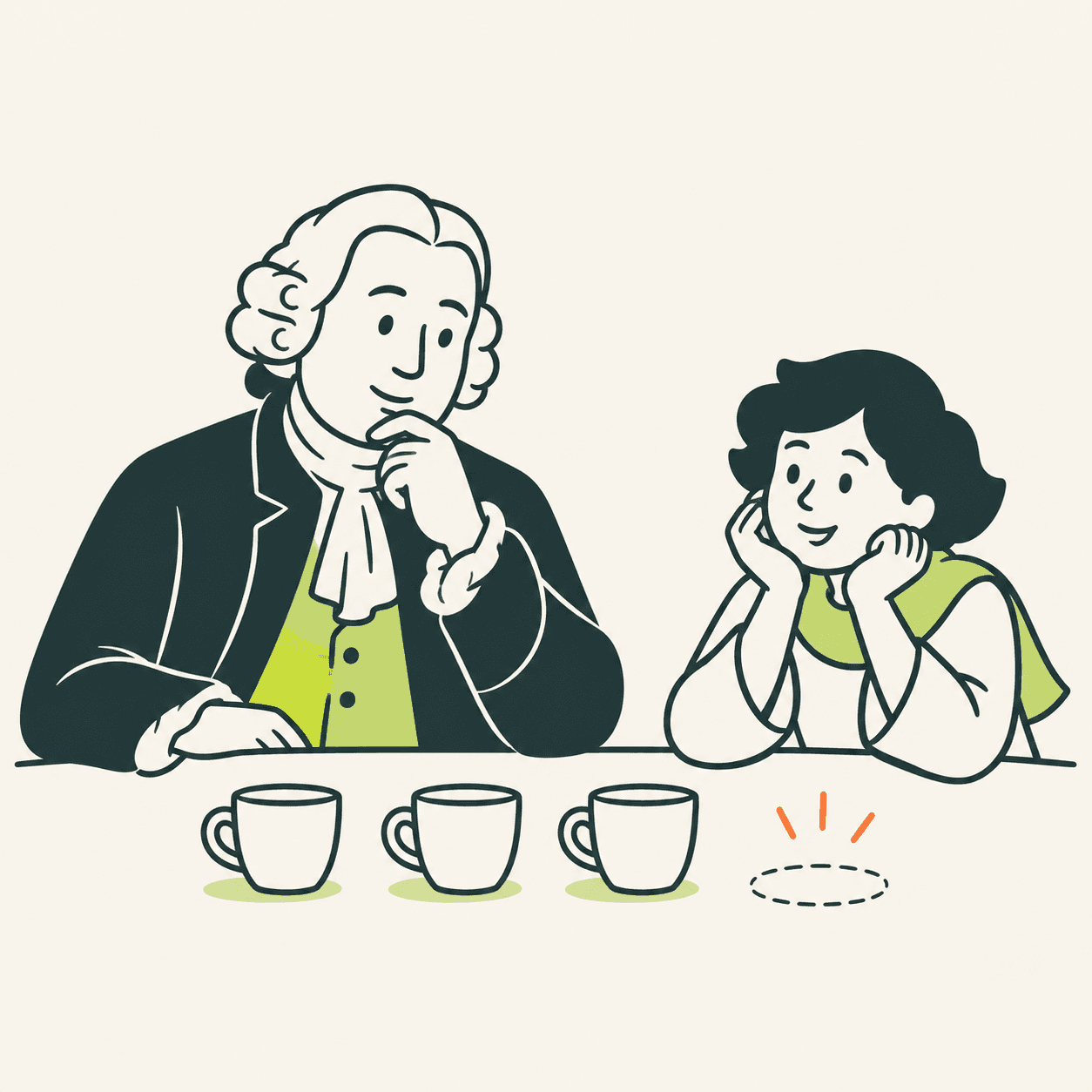
When something has happened many times, we expect it to happen again. The philosopher David Hume examined that step: moving from what we have observed to what we have not yet observed. This is the problem of induction. The term describes reasoning that extends experience beyond the cases we already know, as when we use what happened yesterday to predict what will happen tomorrow. [1]
In An Enquiry concerning Human Understanding, Hume describes habit as the force leading us to expect events that we have often encountered together. This does not mean choosing to think badly every morning. It is a normal way of finding our way through life: earlier experience guides expectation. His question concerns its foundation. Why should the past guarantee, with absolute necessity, a future case that we have never seen? [2]
Here is an example invented by our editors. For a week, a classmate arrives carrying a green backpack. The next morning, we imagine she will bring it again. That expectation is understandable, but she might have left it at home. Counting more green-backpack mornings makes the pattern familiar; it does not make a different backpack impossible. This everyday example cannot solve the philosophical problem. It simply separates remembering a fact from predicting a new one. [2]
One tempting answer is that experience has worked before, so it will work again. The Stanford Encyclopedia of Philosophy explains why Hume regards this answer as circular: we are already using the step from past to future in order to defend that very step. It is like trying to prove a rule by applying the same rule. The difficulty does not vanish just because the reasoning feels familiar or useful. [1]
Hume does not therefore suggest that we should stop learning from experience. His text acknowledges that habit makes practical action possible. Explaining where an expectation comes from and proving its absolute certainty are nevertheless different tasks. Philosophers continue to discuss induction through different interpretations and proposed answers. Turning the problem into a slogan that all predictions are equally good, or that observations are useless, would misrepresent the issue. [2][1]
A small activity from our editors: write a harmless prediction, such as where you will find a book tomorrow. Separate three things: what you have actually seen, what you expect and what might change. Check again the following day. You have not produced a philosophical proof, but you have made a step in your thinking visible. Allowing for another possibility need not prevent a decision; it leaves room for new information. [2]
Take this with youA prediction can be reasonable without being infallible. Asking which observations support it is already a useful way to understand it better.
One idea, in simple words
David Hume studied how we learn from experience. When we see two things happen together many times, we expect the pattern to continue. Hume called this pull of the mind habit. It helps us in everyday life, but an expectation is not a certain promise about the future. [2]
Here is an example invented by our editors. A classmate brings a green backpack to school for five days. We think she will bring it tomorrow too. Perhaps she will, but she could use a different one. The days we have already seen do not make a change impossible. Hume does not ask us to ignore experience. He helps us separate what we observed from what we predict. We can use observations while staying ready to learn from something new. [2]
A little discovery to keep
What did you discover?
Read the sources (2)
- The Problem of Induction Stanford Encyclopedia of Philosophy · accessed 24 Sept 2026
- An Enquiry concerning Human Understanding, Section V Hume Texts Online · accessed 24 Sept 2026
Original writing and illustration made with AI assistance. Our editorial method
More in Philosophy