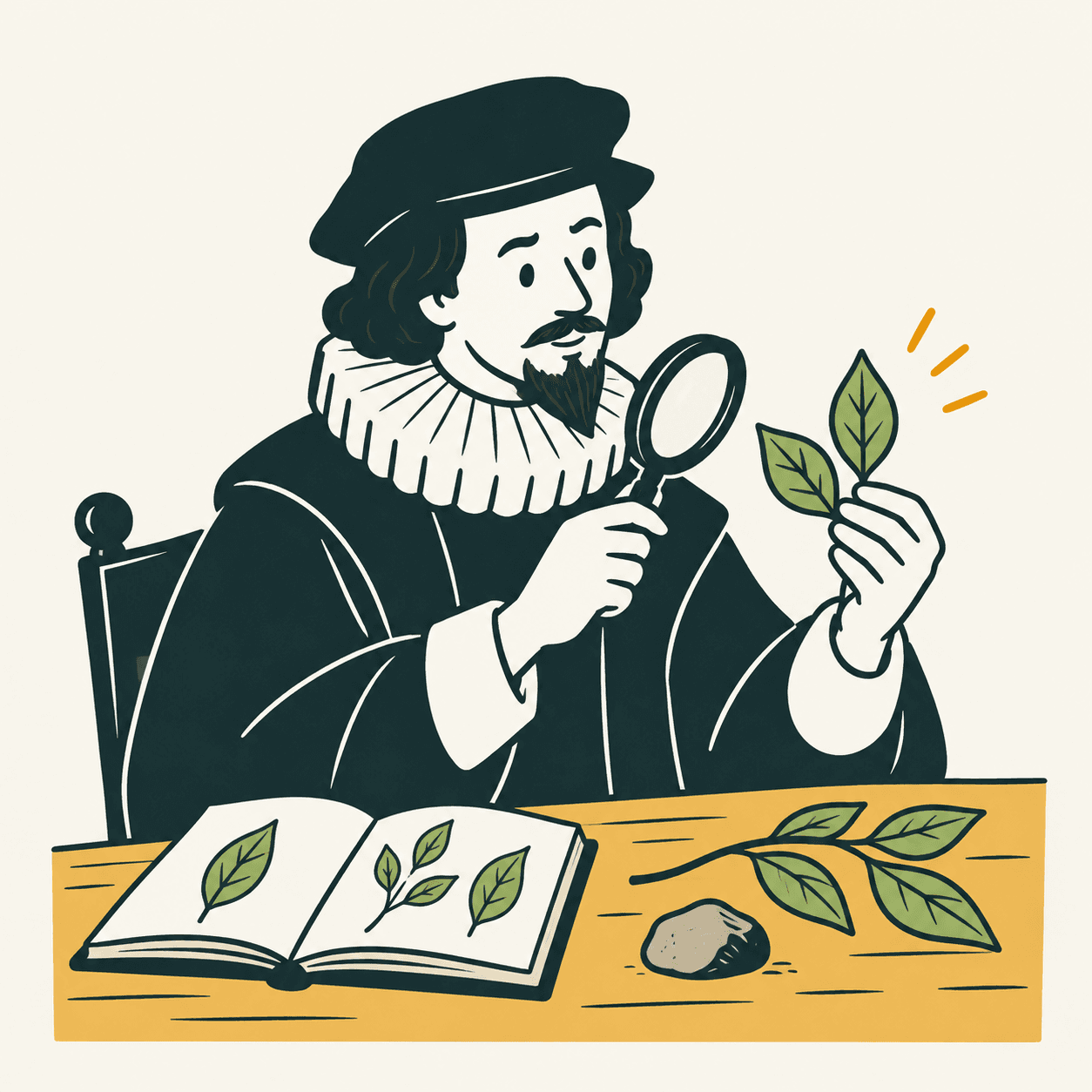
“Natura enim non nisi parendo vincitur”: nature is overcome only by obeying it, in our literal rendering. Francis Bacon wrote this sentence in the third aphorism of Book I of the Novum Organum, published in 1620. Context matters: immediately beforehand, he connects knowledge with the ability to produce effects. He is not asking us to hear a mysterious voice of nature, but to understand causes and respect the conditions under which something can happen. [1][3]
The English edition of 1858, translated by James Spedding and colleagues, gives the passage as “Nature to be commanded must be obeyed”. The tension between command and obedience is deliberate: effective action depends on understanding. We reproduce the short clause with a full stop; the Latin continues with a colon, the English with a semicolon. The Italian and French translations accompanying this feature are editorial translations, rather than historical translations attributed to Spedding. [1][2]
Bacon’s project goes beyond collecting interesting facts. The Stanford Encyclopedia of Philosophy describes a reform of knowledge, with tools to address obstacles in our thinking. In aphorism 46, Bacon observes that, once we adopt an opinion, we tend to favour supporting evidence and overlook contradictions. This is a warning about how we look for evidence: a preferred answer can influence even the questions we choose to ask in the first place. [3][2]
Consider an explicitly editorial example. You have two plant pots and think a particular position might benefit a plant. Before reaching a conclusion, record what you intend to observe and which differences already exist between the pots. If you change position, water and growing medium together, which change are you actually comparing? We are not attributing this experiment to Bacon or promising a botanical result. This imagined situation simply makes the problem of conditions visible. [2]
A second editorial exercise is to draw two columns: what supports my idea, and what might make me revise it. The second should not remain empty on principle. This does not turn a notebook into a complete scientific investigation. Bacon’s seventeenth-century programme has its own historical context and does not coincide with every method used in science today. It nevertheless offers a useful question: am I trying to understand a phenomenon, or merely trying to be right? [3][2]
Take this with youBefore changing a situation, state which conditions you think matter and which observation might prove you wrong. This is our editorial prompt, separate from Bacon’s quotation.
One idea, in simple words
Francis Bacon was a philosopher. In the Novum Organum, published in 1620, he wrote a Latin sentence translated by James Spedding and colleagues as “Nature to be commanded must be obeyed”. This does not mean that plants give orders. It means that, to produce an effect, we need to understand the conditions and causes that allow it to happen. [1][3][2]
Try this editorial example: you want to compare two plant pots. If you change water, soil and position together, it becomes difficult to tell which difference matters. Bacon also warns that we may seek only evidence supporting our opinion. Asking what could make us change our mind is therefore useful. The plant-pot example is ours; it is not an experiment described by Bacon. [2]
A little discovery to keep
What did you discover?
Read the sources (3)
- Novum Organum, liber I, aphorismus III IntraText · testo di Francis Bacon · accessed 8 Oct 2026
- Novum Organum, Book I · translation by James Spedding et al. (1858) Wikisource · Francis Bacon · accessed 8 Oct 2026
- Francis Bacon · philosophy and the reform of knowledge Stanford Encyclopedia of Philosophy · accessed 8 Oct 2026
Original writing and illustration made with AI assistance. Our editorial method
More in Philosophy