It is possible to do a great deal and learn very little. In Democracy and Education, John Dewey distinguishes activity from recognising its consequences. Experience becomes meaningful when we connect an attempt with what follows. Collecting movements, exercises or busy days is insufficient: we need to understand the relationship between the action and its result. [2]
In How We Think, reflection begins with something that presents a difficulty. We identify the problem, suggest a solution, consider its implications and return to observation or experiment. Dewey distinguishes these stages to understand them, not to turn them into a rigid procedure: how much attention each deserves depends on the situation. [1]
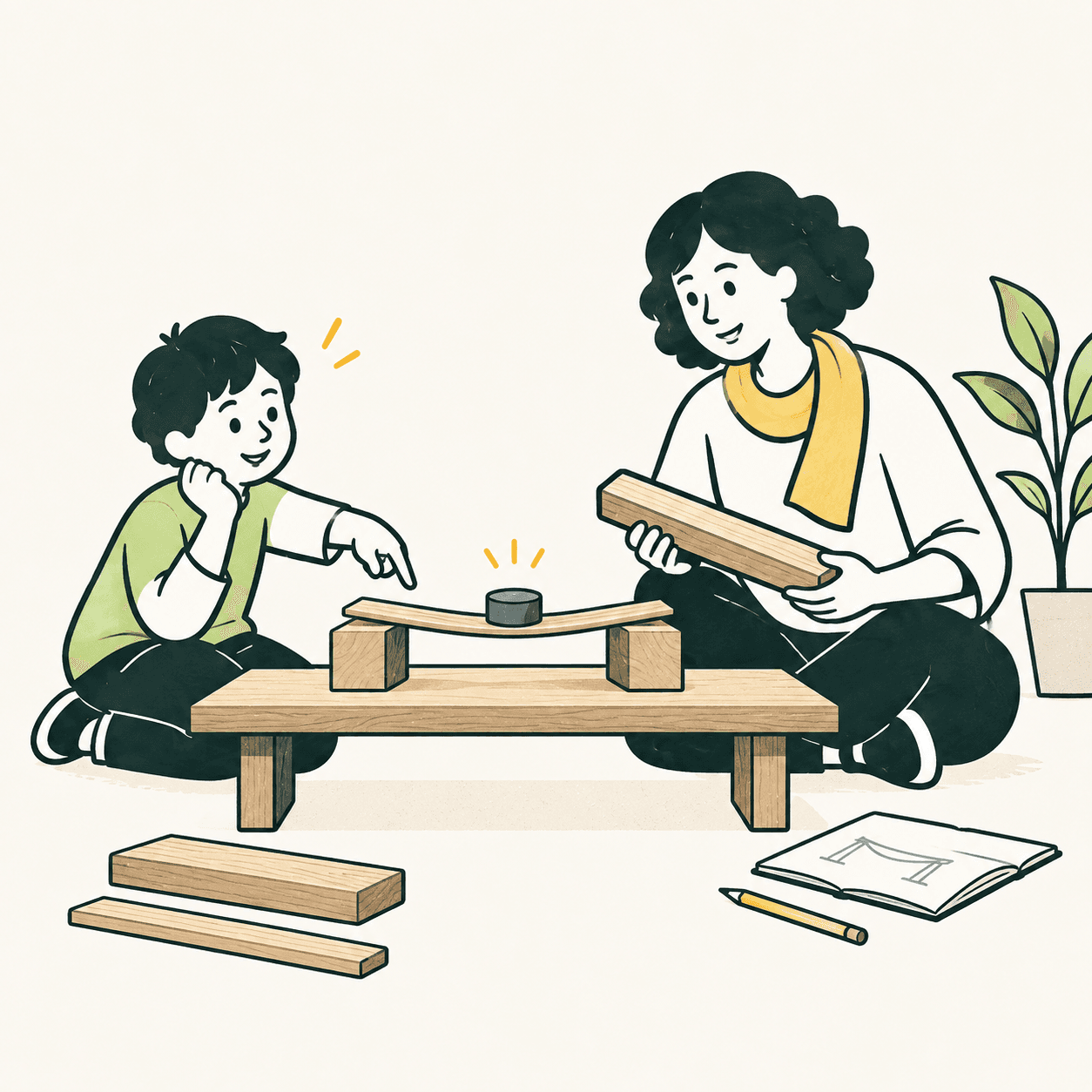
Here is an example devised by our editors. A child wants to balance a wooden bridge between two boxes, but the deck keeps slipping. An adult could put it back every time. Alternatively, they could ask what moved, listen to a suggestion and help test it. Our miniature building site illustrates the difference between receiving a solution and investigating its reasons. [1]
Continuing the example, the pair decide to change just one position and observe the result. If the bridge holds, they have not proved a universal law; they have found a clue under those particular conditions. They can describe what they did and check whether their explanation still makes sense when the load changes. These editorial steps illustrate the connection between action and consequence discussed by Dewey. [2]
The point is not to celebrate every mistake. Dewey distinguishes trial and error from reflection that examines the connections in between: why an action works, which conditions it depends on and what could alter the outcome. Finding a useful answer by chance and being able to examine its reasons are different achievements. The latter helps when circumstances do not repeat themselves exactly. [2]
Curiosity does not remove the need for educational care either. In How We Think, Dewey stresses developing the habit of seeking evidence and withholding judgement. Teachers should recognise productive difficulties within an activity and support the inquiry. Leaving someone alone with interesting materials does not, in his account, guarantee the development of more thoughtful judgement. [1]
Reading these pages today means taking a question seriously, rather than adopting a recipe for every educational problem. Our suggestion is to try it among adults too: after a successful attempt, explain why it should work again. If we cannot, we can keep investigating. Getting a result is satisfying; understanding it requires further work. [1][2]
Take this with youChoose a small activity and note your prediction, the result and one unanswered question. Three lines will do: the minutes of your meeting with reality can be short.
Read the sources (2)
- How We Think — capitoli I, V e VI (1910) John Dewey · Project Gutenberg · accessed 15 Sept 2026
- Democracy and Education — capitolo XI, Experience and Thinking (1916) John Dewey · Project Gutenberg · accessed 15 Sept 2026
Original writing and illustration made with AI assistance. Our editorial method
More in Philosophy