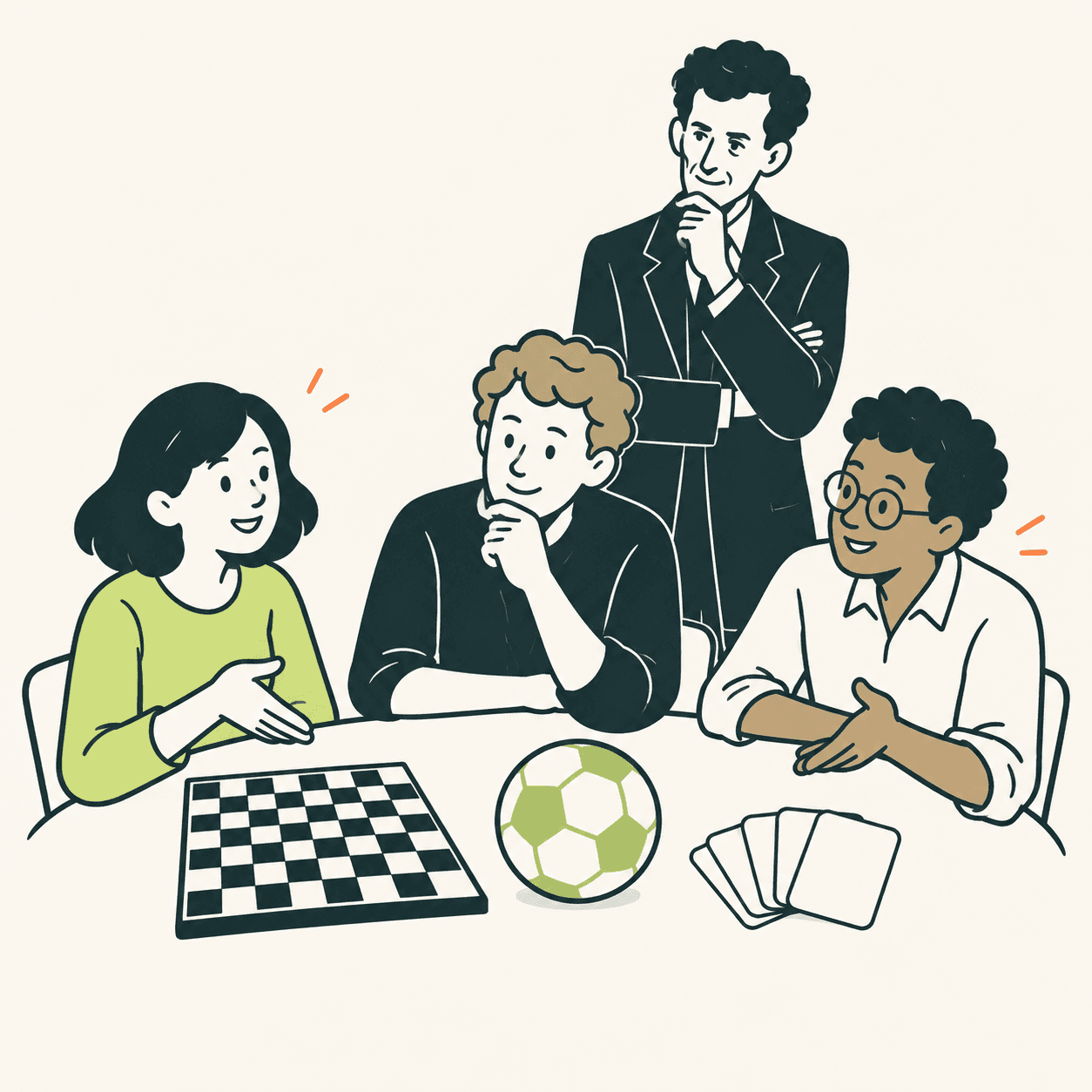
Ludwig Wittgenstein invites us to look closely at an everyday word: game. His later thinking, collected in Philosophical Investigations, published after his death in 1953, introduces family resemblance. As the Stanford Encyclopedia of Philosophy explains, different examples can be connected through overlapping characteristics without necessarily sharing one single property that defines every member of the group. [1]
Consider the proposal without turning it into a slogan. One similarity might connect two cases, while another connects a different pair. The entire chain need not preserve the same feature from beginning to end. Richard Raatzsch’s study of the passage about games also helps mark a limit: this example does not license dismissing every definition as useless or impossible. [3]
An editorial example: invent three activities. In the first, two teams search for treasure. In the second, one person arranges cards according to a rule. In the third, a group builds a tower together without choosing winners. Make columns for teams, rules, materials and victory. We are not proving an entire philosophy with three boxes: we are noticing which comparisons we make. [1][3]
The Internet Encyclopedia of Philosophy describes Wittgenstein’s attention to how language is used: what we do with words in our activities matters too. His reference to language-games does not mean that speaking is always a competition. It directs attention to practices and situations instead of automatically seeking a hidden object behind every word. This is a philosophical perspective, not an experimental formula about the brain. [2]
Continue with an editorial thought experiment. Imagine someone saying, “We played well,” after losing a match, and another person saying it after collaborating in an activity without scores. Before correcting them, ask what they mean. Write down their answers without forcing them to match. These scenes are invented by the editors, not biographical episodes or quotations from Wittgenstein. The useful question concerns the standard each person is applying in that situation. [2]
Our final suggested exercise is to choose a familiar word and collect different examples before writing its definition. Look for places where your first definition helps and places where it needs an addition. Discuss them without declaring every possible use automatically correct. This small collection is a tool for asking better questions, not a test of who belongs to a family or a method for sorting people into categories. [1][3]
Take this with youRemember: different similarities can form a network between examples; searching for one identical feature is not always the best starting point.
One idea, in simple words
What makes a game a game? The philosopher Ludwig Wittgenstein invited people to compare different examples. Some involve cards, others a ball. Some are competitions and others are not. He described family resemblance: connections that overlap without requiring one identical feature in every case. This is a way of examining similarities carefully. [1][3]
Here is an example invented by our editors. A treasure hunt has teams; a card solitaire has rules but just one player; building a tower together might have no winners. We can look for similarities and differences. This does not mean every definition is useless. It means pausing to observe how we use a word before demanding that all its examples be identical. [1][3]
A little discovery to keep
What did you discover?
Read the sources (3)
- Ludwig Wittgenstein Stanford Encyclopedia of Philosophy · accessed 1 Oct 2026
- Wittgenstein, Ludwig Internet Encyclopedia of Philosophy · accessed 1 Oct 2026
- Philosophical Investigations 65ff: On Family Resemblance Wittgenstein Archives at the University of Bergen · accessed 1 Oct 2026
Original writing and illustration made with AI assistance. Our editorial method
More in Philosophy