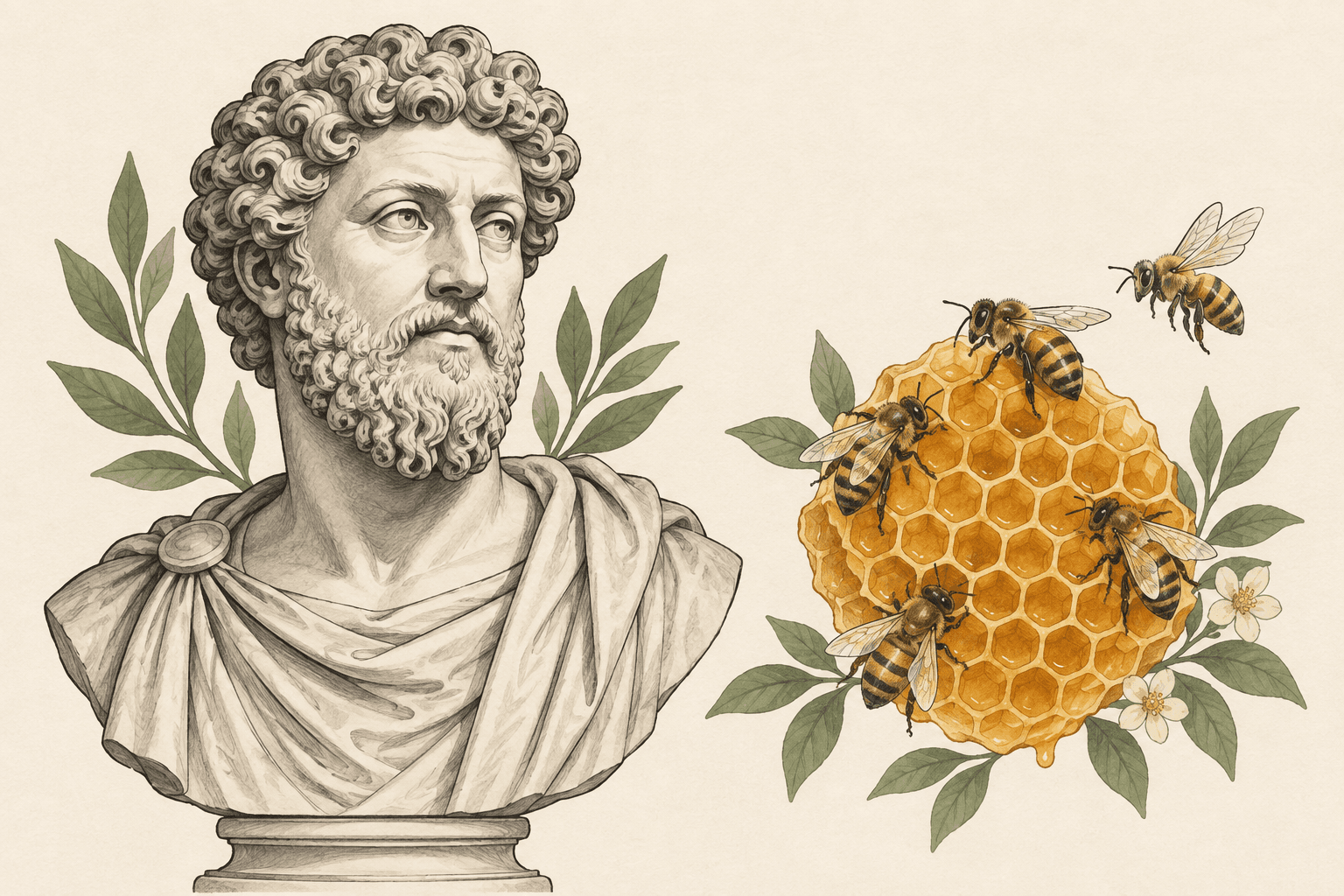
Marcus Aurelius was a Roman emperor and Stoic philosopher of the second century. The Meditations did not begin as a collection of slogans designed to win an audience: the Stanford Encyclopedia of Philosophy describes exercises addressed to himself. That purpose changes how we read them. We encounter someone trying to bring principles into practice, rather than a certificate proving that he always lived up to every sentence. [1]
In Book VI, section 54, he writes: “Τὸ τῷ σμήνει μὴ συμφέρον οὐδὲ τῇ μελίσσῃ συμφέρει.” George Long translates: “That which is not good for the swarm, neither is it good for the bee.” We checked the Greek in Jan Hendrik Leopold’s edition hosted by Perseus against Long’s English translation. The image links a part with the whole to which it belongs, rather than treating personal advantage as an isolated object. [2][3]
The same book supplies a wider context: in section 44, Marcus distinguishes Rome, his city as emperor, from the world, his city as a human being. We can therefore read the swarm as an image for questioning how people live together. There is no need to credit him with a modern theory of ecosystems or present the sentence as a scientific finding about bees. The passage concerns choices and actions. [3]
Imagine an editorial example: five people are preparing a school newspaper, and one keeps every useful piece of information private in order to seem indispensable. That might look like an immediate advantage. The question suggested by the sentence is different: what happens to the shared work on which that person’s own contribution also depends? This is an invented situation for testing a philosophical lens, not a documented episode from antiquity. [3]
Our reading also needs a caution: invoking the common good does not automatically decide who is right. In the example, someone might challenge an unfair decision precisely to improve the newspaper. The sentence does not excuse us from hearing that challenge. Used as a question, it opens discussion about personal and shared consequences; used as an order to be silent, it stops helping the reasoning we meant to practise. This distinction is editorial commentary. [3]
Take this with youBefore calling a choice beneficial, ask for whom and for how long. Then listen to those affected: the question stays open after the quotation ends.
One idea, in simple words
Marcus Aurelius was a Roman emperor who thought about how to act. In his book, he compares a person with a bee in a swarm, which means a group of bees. He writes that what does not help the swarm does not help the bee. This is an image for thinking about people’s relationships, not a scientific discovery about bees. [3]
Here is an editorial example: a class makes a newspaper. If someone hides useful information, the shared work becomes harder. The sentence invites us to look beyond our immediate advantage. It does not mean everyone must always agree. Asking a question or pointing out an unfair choice may help the group. People still need to listen and think about consequences. [3]
A little discovery to keep
What did you discover?
Read the sources (3)
- Marcus Aurelius Stanford Encyclopedia of Philosophy · accessed 7 Oct 2026
- M. Antonius Imperator Ad Se Ipsum · VI.54 · Jan Hendrik Leopold, 1908 Perseus Digital Library · Tufts University · accessed 7 Oct 2026
- Meditations · Book Six · translated by George Long MIT · Internet Classics Archive · accessed 7 Oct 2026
Original writing and illustration made with AI assistance. Our editorial method
More in Philosophy