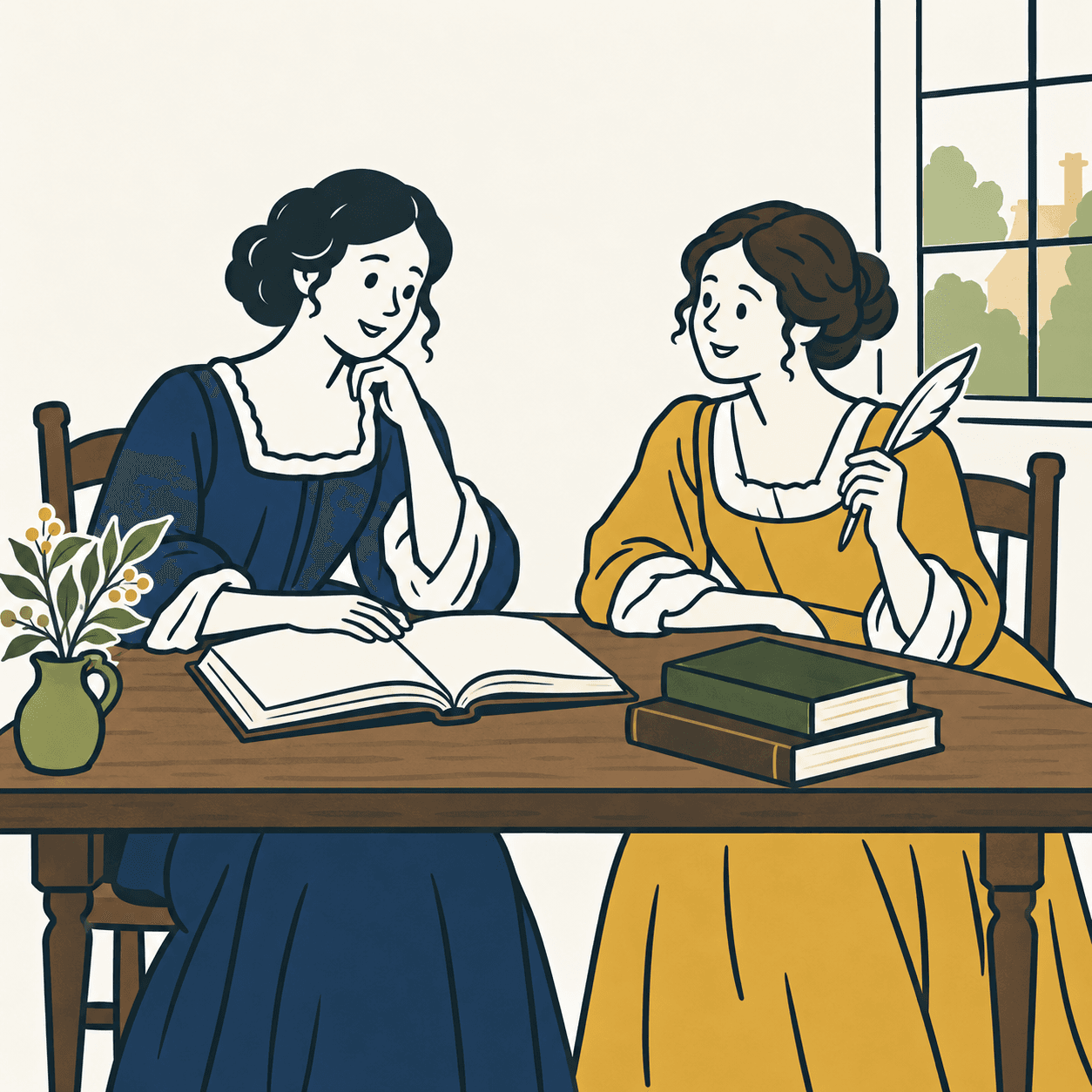
When someone cannot do something, how much depends on their opportunities to learn? Mary Astell, an English philosopher who lived from 1666 to 1731, placed this question at the centre of her defence of women’s education. In the first A Serious Proposal to the Ladies, published in 1694, she challenged the idea that shortcomings attributed to women demonstrated a natural inability. [1][2]
The text makes a pointed argument: deny someone an education and then reproach them for what they do not know, and the outcome of exclusion becomes its own justification. Astell gives considerable weight to education and cultivated habits. Her project encourages its intended readers to study and exercise their intellectual abilities, rather than measuring their worth only through the approval they receive from other people. [2]
The second part, published in 1697, proposes rules for ordering thought. First, understand the precise question and the words being used; then separate relevant ideas from distractions, proceed from simpler ideas to more complex ones, and examine every part. Judgement should stop where understanding ends. These directions belong to a religious, rationalist philosophy, rather than a modern technique for becoming more productive. [2]
An example invented by our editors: a group needs to choose a book to read together, and someone simply suggests picking the best. Before voting, ask what best means: shorter, more accessible, or more interesting for the chosen topic? Write down a criterion, compare two suggestions and identify the information you still need. There is no need to win the discussion immediately. This contemporary exercise takes clarity as its starting point; Astell was not organising our reading group. [2]
The historical context needs to stay in view. The Stanford Encyclopedia of Philosophy explains that the Ladies addressed by the proposal were primarily women of the nobility and gentry, the landowning classes. Astell’s imagined educational retreat aimed at moral and spiritual development. It did not correspond to professional training or the university open to everyone that we might imagine today. The value of her question does not remove these boundaries. [3]
We can therefore revisit the example with a second editorial question: could everyone in the group find the book, read an extract and understand the criteria? Before treating an uncertain contribution as evidence of limited ability, record what opportunities for preparation we actually offered. This is a suggestion for examining a concrete situation, not an automatic explanation of every difficulty. Its purpose is to make judgement more attentive while preserving the historical distance between the philosopher and ourselves. [2][3]
Take this with youThe next time you say someone cannot do it, first describe the opportunities that person has had to learn.
One idea, in simple words
Mary Astell was an English philosopher. She argued that women should have opportunities to study. If someone receives no teaching, what they do not know does not prove a natural inability. Her book also explained how to think in an orderly way. First, understand the question and the meaning of its words. Then examine the different parts of the problem. [2]
Here is our editorial example: choose a book for a group. Before deciding which is best, agree on what you want: a short story or a particular subject? Astell’s project had a specific context. It mainly addressed women from privileged classes and had a religious purpose. It was different from school today. [3]
A little discovery to keep
What did you discover?
Read the sources (3)
- Mary Astell (1666–1731) Internet Encyclopedia of Philosophy · accessed 3 Oct 2026
- A Serious Proposal to the Ladies, in Two Parts (1697) Mary Astell / Project Gutenberg · accessed 3 Oct 2026
- Mary Astell Stanford Encyclopedia of Philosophy · accessed 3 Oct 2026
Original writing and illustration made with AI assistance. Our editorial method
More in Philosophy