William James, who lived from 1842 to 1910, was a philosopher and psychologist. At Harvard, he helped establish the teaching of psychology. He studied the mind as part of everyday life: what we notice, repeat and choose. His education crossed art, medicine and physiology, which is the study of how the body works. These interests gave him several ways to ask questions about experience. [1][4]
In The Principles of Psychology, published in 1890, he described attention as selection: among several possible things, one becomes clearer and more present. He was not saying that the rest of the world disappears. He was observing that things do not all occupy the centre of our experience equally. It is the difference between having a sound around us and actually listening to it. [2]
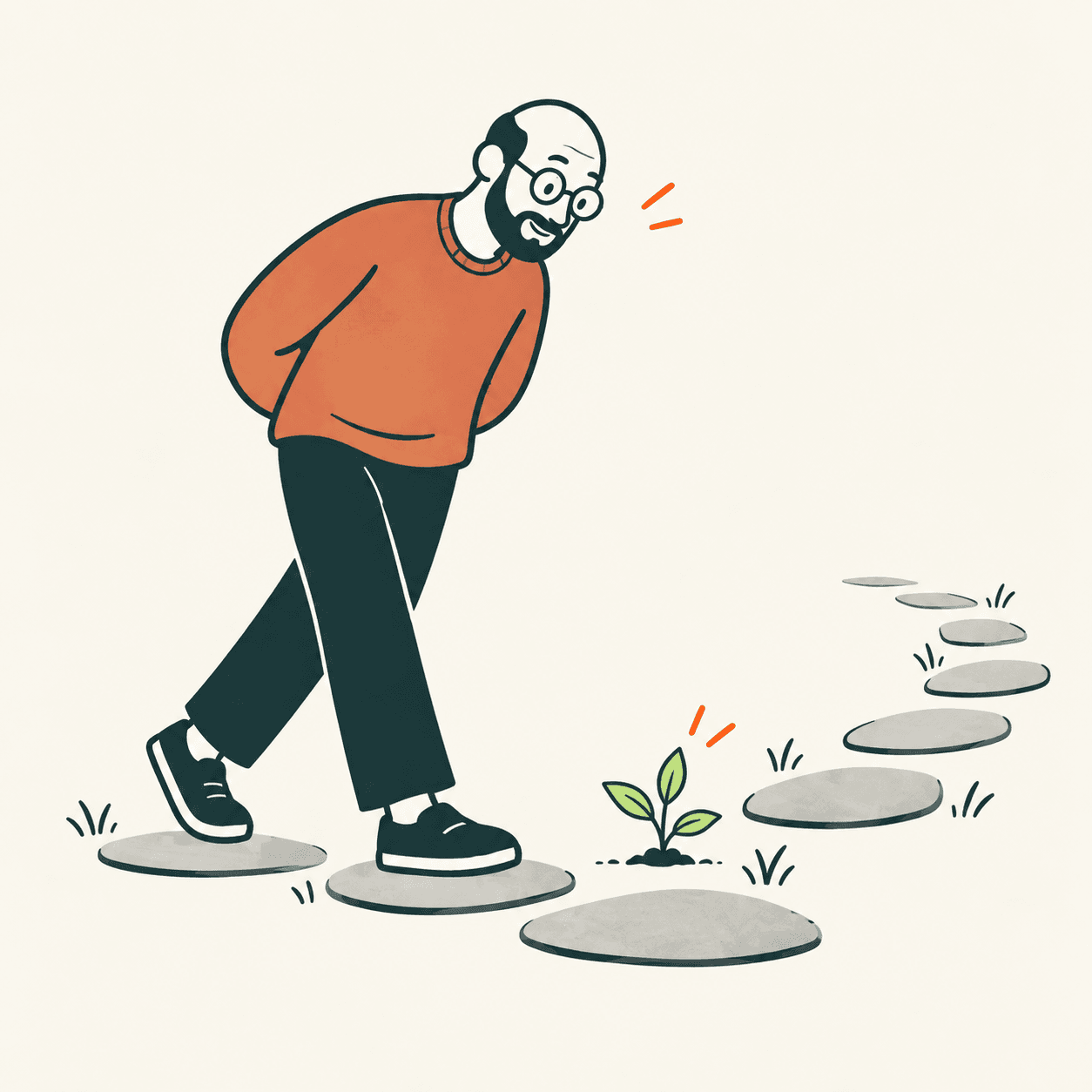
Consider a scene invented by our editors. Two friends walk along the same pavement. One looks for a building number; the other notices a little plant between the stones. They are not walking through two different cities: they have selected different details of the same street. By telling each other what they saw, each discovers something they had missed. This example illustrates selective attention; it does not measure it in an experiment. [2]
James also devoted a chapter to habits. Repeating an action can make it easier and require less conscious attention: we do not need to work out all the steps afresh. But a habit can also keep a sequence going when circumstances change. His examples include ordinary gestures and small automatic mistakes, rather than only the major decisions in a person’s life. [3]
Imagine, again as an editorial example, always leaving a notebook on the same shelf. One morning we move it, and our hand returns to its usual place. We can pause, look and search elsewhere. This story does not prove that every distraction comes from habit. It helps separate two questions: what am I doing automatically, and what needs my attention right now? We do not need to turn every gesture into a test. [3]
We should read James as a historical author, rather than as an up-to-date medical manual. The Stanford Encyclopedia of Philosophy places these investigations within his philosophical development and the debates of his time. His descriptions can prompt thought; they do not justify diagnoses or promises of improvement. Even the word choice needs care: our exercise does not blame people who find concentration difficult. [4]
Take this with youChoose a familiar object and describe one detail you have never mentioned before. Then listen to another person’s choice: a small comparison, with no points or rankings.
One idea, in simple words
William James was a philosopher and psychologist. He asked questions about how people think. In a book published in 1890, he explained that attention selects something from the many things around us. Other things do not vanish, but we notice them less. [2][1]
Here is an example invented by our editors. Two friends walk along one street. One looks for a house number. The other notices a tiny plant. They see different details because they are paying attention to different things. [2]
James also wrote about habits: actions we repeat until they need less thought. A familiar action may continue even when something changes. These are ideas from an old book, not a test of how good you are at concentrating. You can simply try noticing one new detail today. [3]
A little discovery to keep
What did you discover?
Read the sources (4)
- William James Harvard University, Department of Psychology · accessed 21 Sept 2026
- The Principles of Psychology, Chapter XI: Attention (1890) William James; digital edition, York University · accessed 21 Sept 2026
- The Principles of Psychology, Chapter IV: Habit (1890) William James; digital edition, York University · accessed 21 Sept 2026
- William James Stanford Encyclopedia of Philosophy · accessed 21 Sept 2026
Original writing and illustration made with AI assistance. Our editorial method
More in Philosophy