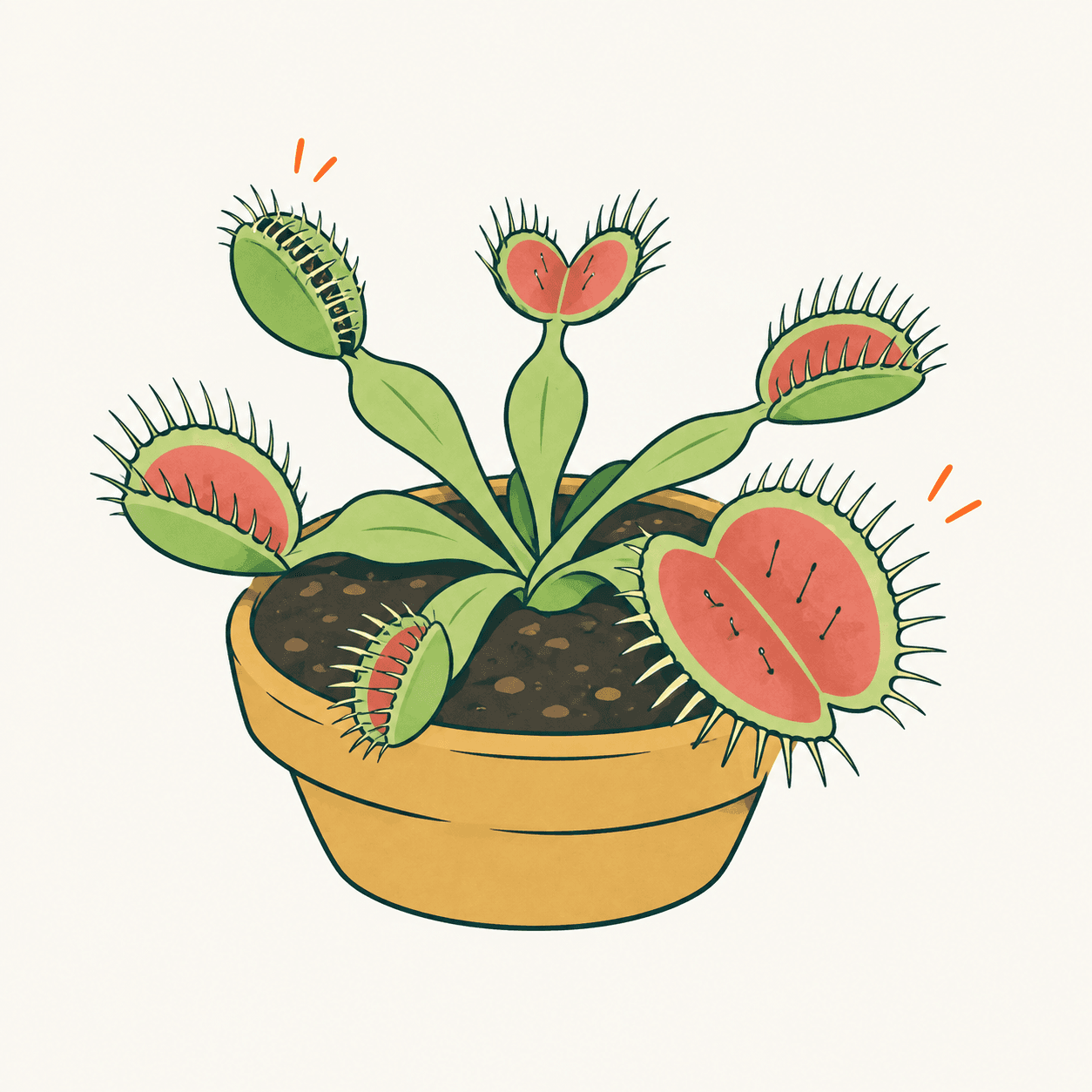
Dionaea muscipula forms a small rosette of leaves. Their tips carry traps with two lobes, often reddish inside, and marginal bristles that interlock when the trap closes. Those are not teeth: we are still very much in the plant kingdom. [1]
Kew explains that, typically, two closely spaced touches to sensitive hairs trigger closure: two hairs can be touched, or the same one twice. Captured prey supply nutrients that are scarce in the ground; carnivory is a response to nutrient-poor soil. [2]
Take this with youThe little discovery is a leaf transformed into a trap. Our own joke: even this botanical doorkeeper waits for confirmation before closing.
Read the sources (2)
- Dionaea muscipula — Venus flytrap Royal Horticultural Society · accessed 10 Sept 2026
- Carnivorous plants explained: Venus flytraps, pitcher plants & more Royal Botanic Gardens, Kew · accessed 10 Sept 2026
Original writing and illustration made with AI assistance. Our editorial method
More in Plants