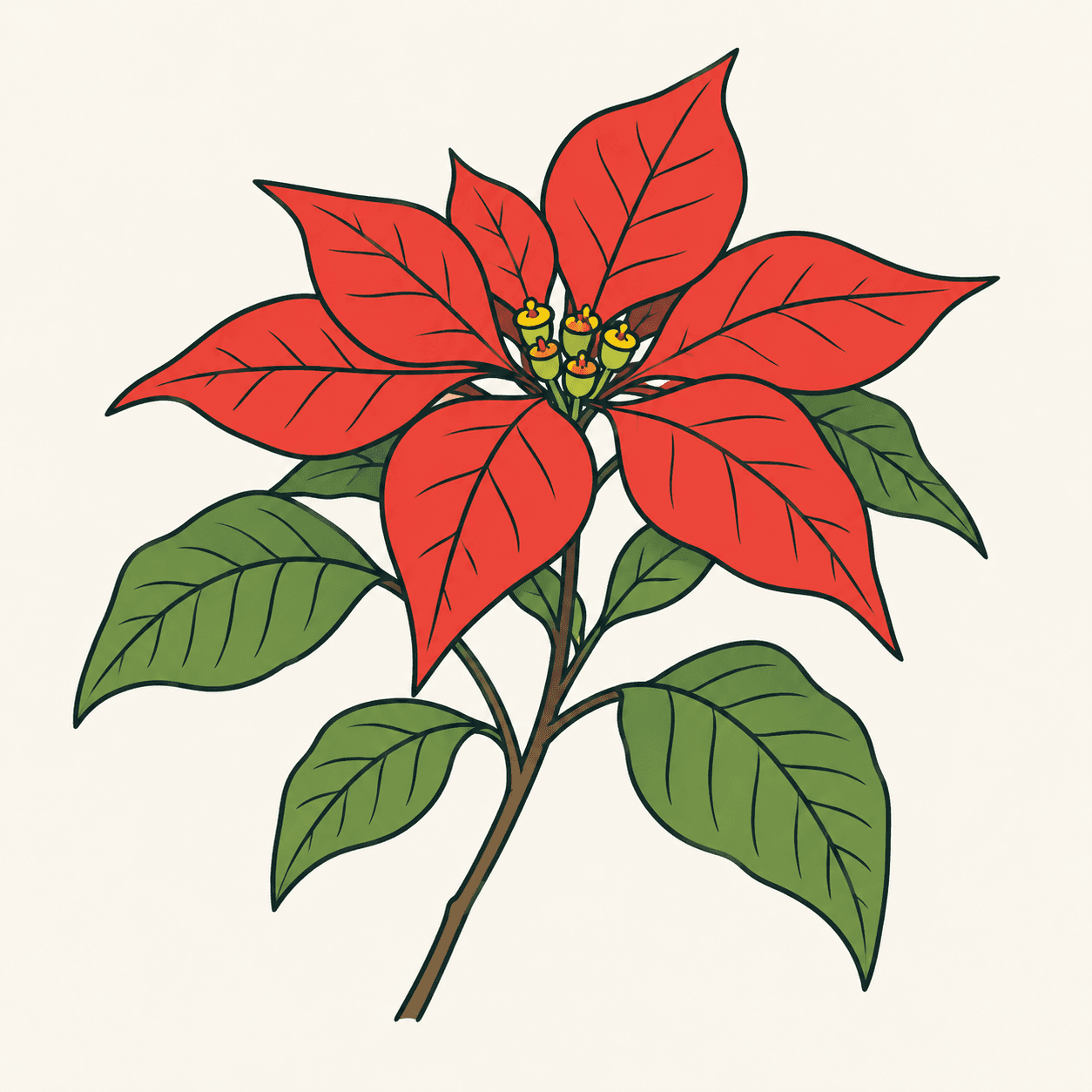
When you look at a poinsettia, the red parts immediately catch your eye. But calling those broad surfaces petals means stopping at appearances. They are bracts: modified leaves associated with flowering. The small green and yellow structures at the centre deserve a closer look instead. Iowa State University specifically distinguishes this central part from the colourful frame. A showy shape and a flower are not necessarily the same thing. [1]
Kew’s botanical description explains what a distant photograph conceals. The true flowers are tiny and have no petals. They are grouped in cup-shaped structures called cyathia. Each cyathium contains male flowers around a female flower and has a yellow gland. Large red bracts surround these small groups. The star shape we notice is therefore an arrangement of several different parts, rather than one large red flower. [2]
The rest of the plant deserves attention too. Euphorbia pulcherrima is a shrub native to Mexico and Guatemala, rather than simply a seasonal windowsill decoration. North Carolina State University describes green, pointed, oval leaves whose edges can be smooth, lobed or toothed. The compact shape of cultivated pot plants does not show every form that the species can take. Looking beyond the colourful top helps reveal the whole plant. [3]
The timing of its colour also depends on light. The University of Wisconsin explains that sufficiently long, uninterrupted periods of darkness, repeated over several weeks, help trigger flowering and changes in the bracts. This is the behaviour of a short-day plant. It does not mean that someone paints the leaves, or that switching off a lamp for one evening is enough: the plant responds to conditions maintained over time. [4]
Here is an editorial exercise using a botanical photograph. First draw only the red outline, then add the small central groups in another colour. Your first drawing will capture the silhouette we recognise from a distance; the second will separate structures with different roles. The comparison is for careful observation, not for identifying a variety by colour alone. Poinsettias can also have pink, white or patterned bracts. [1]
This distinction has a useful limit: not every colourful part of every plant is a bract. Here the correct name comes from the structure botanists describe, not from a universal rule about red. There is no need to tear or cut anything to observe this plant: damaged leaves and stems release milky sap. A close photograph already lets you follow the shapes and compare them with the botanical description. [3]
Take this with youBefore calling something a flower, ask which part you are actually looking at. The smallest detail can change how you read the whole plant.
One idea, in simple words
A poinsettia has a surprise. Its large red parts are not petals: they are called bracts, which are modified leaves. Small green and yellow groups at the centre contain the real flowers. So, if you want to find the flowers, you need to look more closely. The colourful frame and the flowers are different parts of the plant. [1]
Here is an editorial example. Imagine drawing the plant with two pencils: red for the bracts and yellow to mark the small central groups. Your drawing shows where to look, but it is not an exact photograph. Some varieties have pink or white bracts. Colour alone therefore cannot tell you whether a part is a petal. [3]
A little discovery to keep
What did you discover?
Read the sources (4)
- Guide to Selection and Care of Poinsettias Iowa State University Extension and Outreach · accessed 4 Oct 2026
- Euphorbia pulcherrima Willd. ex Klotzsch — General information Royal Botanic Gardens, Kew · accessed 4 Oct 2026
- Euphorbia pulcherrima NC State Extension · accessed 4 Oct 2026
- Poinsettia Trivia & Care University of Wisconsin–Madison Division of Extension · accessed 4 Oct 2026
Original writing and illustration made with AI assistance. Our editorial method
More in Plants