Italian gioco comes from Latin iocus, a joke or jest, as recorded by Treccani. Starting with that fact, let us ask our own question: is knowing a word’s origin enough to understand a sentence? In the examples below, we will look for clues without turning a documented origin into an obligatory explanation for every situation we encounter. [1]
Today gioco can mean an activity chosen for enjoyment, a competition or even an effect of light and shadow. These are among the meanings listed in Treccani’s Thesaurus. Context helps us select the right one: the other words in a sentence and the situation. A gioco of shadows on a wall does not need a team, a referee or a scoreboard. [2]
A useful relative is giocoso. Treccani traces it to Latin iocosus, derived from iocus, and connects it with something playful or meant to amuse. We can describe a tone as giocoso without discussing a match. This shows one branch of the family: the connection with joking remains recognisable, while the word does a different job in the sentence around it. [3]
Ludico, meanwhile, belongs to the family of Latin ludus, another word connected with play. Similar meanings therefore do not prove descent from the same form. Treccani’s entry describes the adjective as concerning play, including free and imaginative activities. If an Italian workshop has a parte ludica, this can simply mean that it includes some play: an unfamiliar word may have a very ordinary explanation. [4]
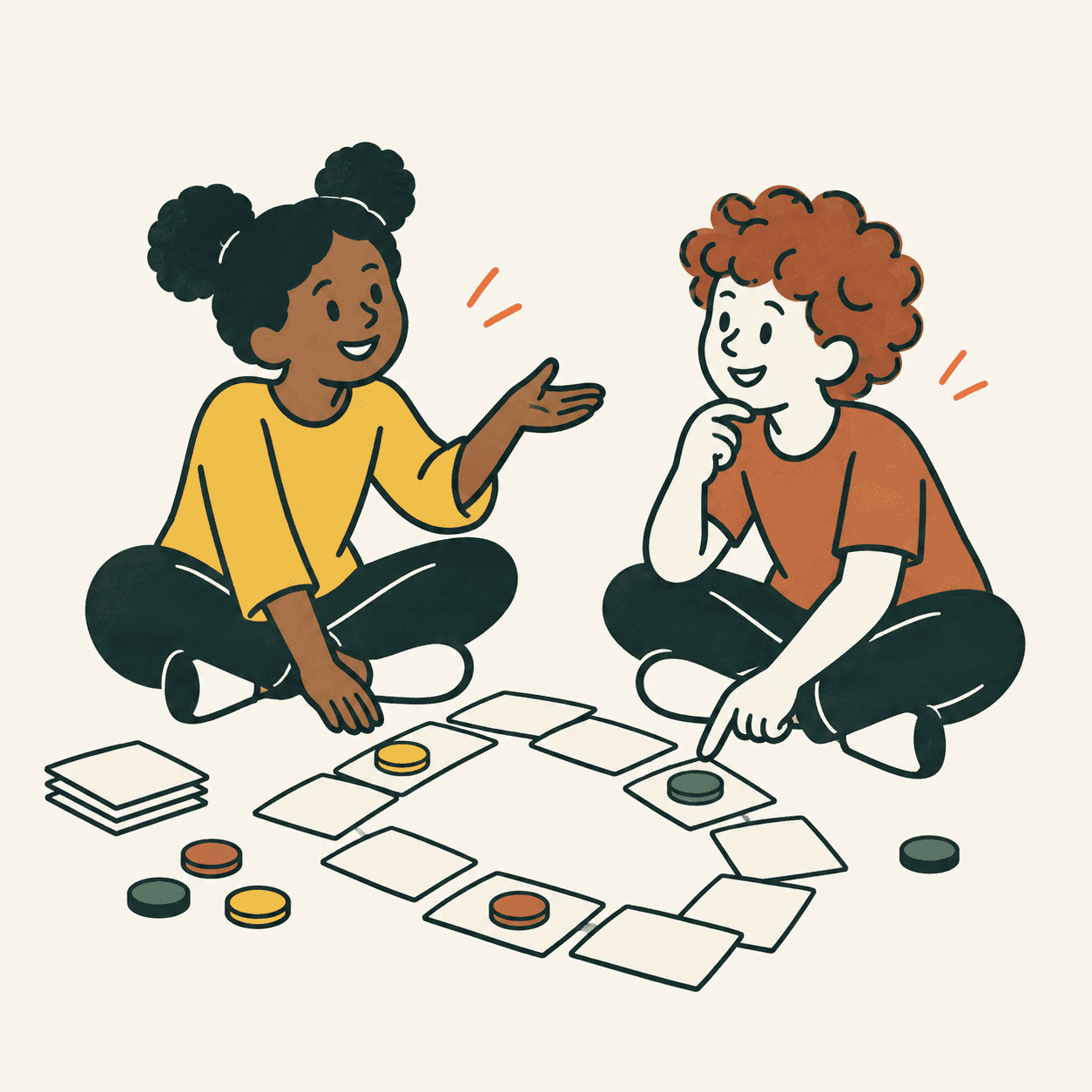
Our editors invent this scene. Two children draw a route with coloured circles and agree on how to cross it. They then change a rule so another child can join in. In Italian, we might describe them as giocando, say that they invent a gioco and call the atmosphere giocosa. None of these sentences proves an etymology; examples help us explore usage. For origins, we return to the dictionary instead of inventing an appealing story. [5][3]
Consider three more invented sentences: a cat gioca with string; a team gioca at home; light creates a gioco on the wall. We do not need one meaning to fit all three. We can ask who acts, what happens and whether shared rules exist. This exercise separates meaning in a sentence from word origin. This English account concerns the Italian word gioco throughout; it does not give the English words game or play a Latin origin because their meanings overlap. [5][2]
Take this with youInvent two Italian sentences using gioco in different ways. Explain which nearby word helps you distinguish the meanings: you are exploring context, without needing a new etymology.
One idea, in simple words
Italian gioco comes from Latin iocus, a joke or jest. Etymology studies where words come from. [1]
Words can have several meanings today. In Italian, gioco can describe an activity, a competition or an effect of light. The words around it help us understand. Giocoso means playful or joking; ludico also concerns play but comes from a different Latin word, ludus. [2][3][4]
Here is an example invented by our editors: children make a route with coloured circles and agree on the rules. They are playing a gioco. Now imagine shadows on a wall: that can be a gioco too. We are explaining the Italian word, not the origin of the English words play and game. [5][2]
A little discovery to keep
What did you discover?
Read the sources (5)
- Gioco — Vocabolario on line Treccani · accessed 21 Sept 2026
- Gioco — Thesaurus 2018 Treccani · accessed 21 Sept 2026
- Giocoso — Vocabolario on line Treccani · accessed 21 Sept 2026
- Ludico — Vocabolario on line Treccani · accessed 21 Sept 2026
- Giocare — Vocabolario on line Treccani · accessed 21 Sept 2026
Original writing and illustration made with AI assistance. Our editorial method
More in Words