From the archive: the edition of , with the original dates and sources for every story. Read the latest edition.

Music for today ·

Edition of 12 November 2026

N° 060 8 stories to take with you

Perspectives.

ITALY, THE WORLD AND NEW POSSIBILITIES
ScienceThe good news

WHO updates its map of tuberculosis drug resistance

The third catalogue draws on more than 71,000 clinical bacterial isolates from over 75 countries, providing a reference for interpreting tests.

AI illustration · Positive Times · ImageGen

The glass is half full.
And someone is filling it.

Read our manifesto

Moving forward.

THINGS CHANGE. ONE STORY AT A TIME.
CultureThe good news

AI answers; the class checks: UNESCO’s new guide

Published on 10 November, a companion to the media-literacy curriculum offers activities on artificial intelligence, its limits, sources and responsibilities.

AI illustration · Positive Times · ImageGen

WorldThe bright side

Madagascar brings climate risks into school planning

A 10 November update describes four regional workshops held from February to October. They inform decisions, rather than certify that schools are already safe.

AI illustration · Positive Times · ImageGen

Little Discoveries

A little more to discover.

Design · Philosophy · Plants · Curiosities · Words · Food · Cultures & peoples. Ideas worth a closer look.

Read all 7 discoveries

Original illustrations made with AI assistance. Facts and sources stay in plain sight.

A chart a day

Edition of
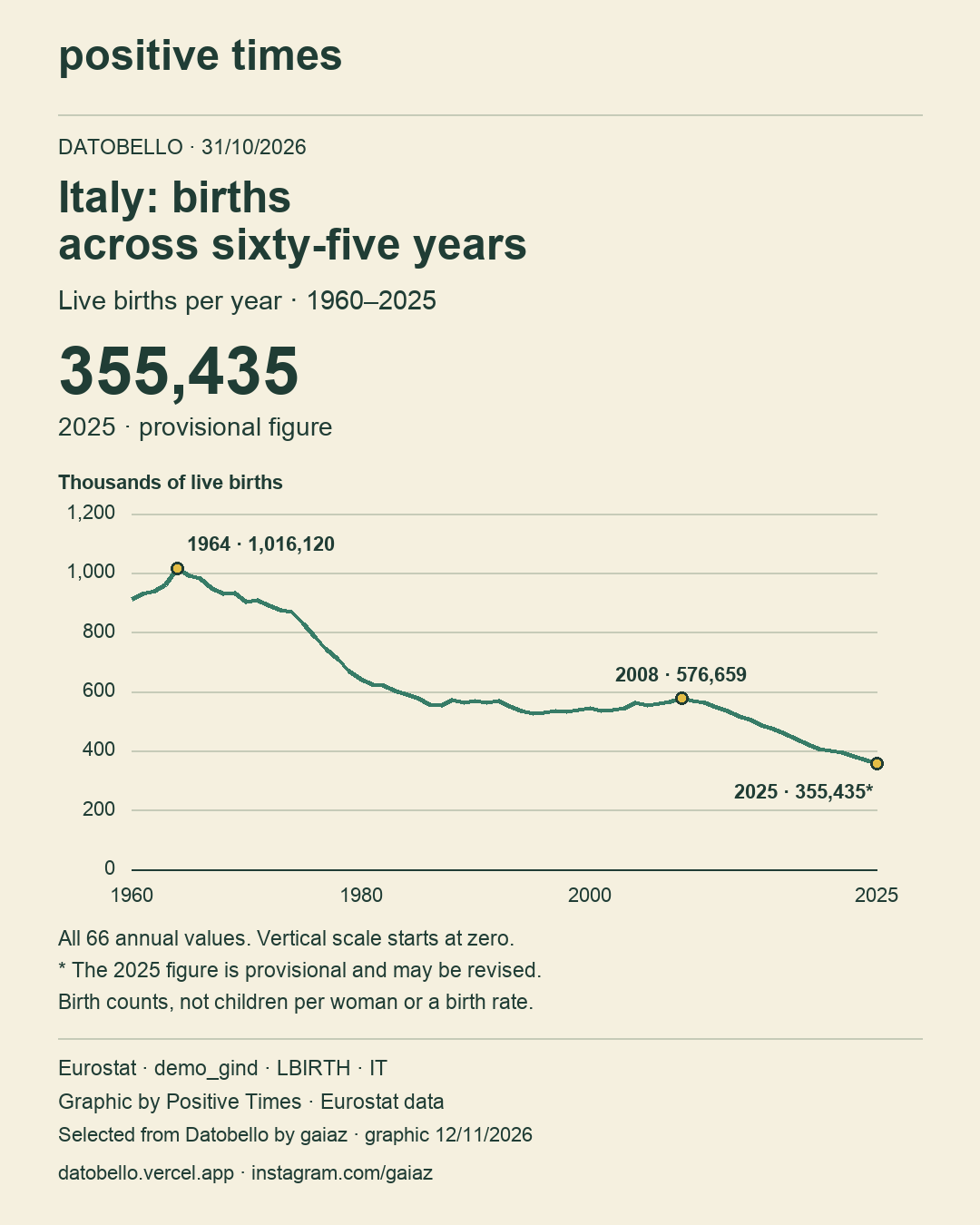
Line chart of live births in Italy, 1960–2025: 66 annual observations on a scale from 0 to 1.2 million. Peak in 1964, 1,016,120; 576,659 in 2008; 355,435 in 2025, provisional. This is not a birth rate.Enlarge the chart
Graphic by Positive Times · Eurostat data · selected from Datobello by gaiaz

Italy: births across sixty-five years

Data period
1960–2025
Datobello chart dated

Eurostat records 1,016,120 live births in Italy in 1964, the highest value in the 1960–2025 series shown here. There were 576,659 in 2008 and 355,435 in 2025. The latest figure is provisional. The line shows every annual value, not just the endpoints. [1]

These are live-birth counts in Italian demographic statistics, without restricting them to Italian citizenship. They do not measure the average number of children per woman. Eurostat identifies birth registrations in municipal population registers as the Italian source. [2]

This is a historical overview, not an event from 12 November. Data updated on 27 October 2026; Datobello selection dated 31 October; adaptation prepared on 12 November. Original writing and graphic by Positive Times: Eurostat is not responsible for the translations or adaptation. [1][3]

Visit Datobellodatobello.vercel.app

A project by gaiaz · Instagram

View the sources
  1. Population change: live births, Italy, 1960–2025 (demo_gind / LBIRTH) Eurostat · No publication date provided · Accessed
  2. Fertility — reference metadata: live births, annual period and Italian source Eurostat · Published · Accessed
  3. Oggi in Italia nasce un bambino ogni tre del 1964 Datobello · gaiaz · Published · Accessed

That is quite a lot of good for one day.

Browse the other editions